


Sunflower losses are a symptom of chemistry, not “just white rot”
Greening agro is not a fad, but a reaction to the fact that excess nutrients are becoming a source of soil and water pollution, and biodiversity loss.


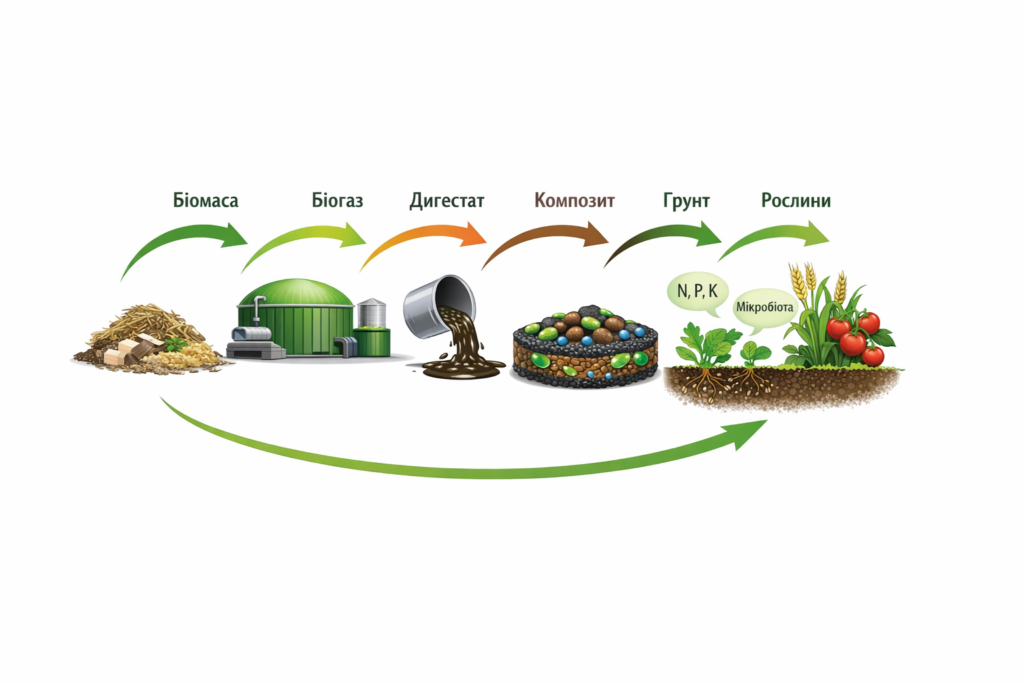
The global transition to a low-carbon economy is accompanied by the rapid development of renewable energy technologies and circular bio-waste management. Among such technologies, anaerobic digestion of organic raw materials occupies a special place, which allows simultaneously obtaining renewable energy in the form of biogas and a secondary material product – digestate.
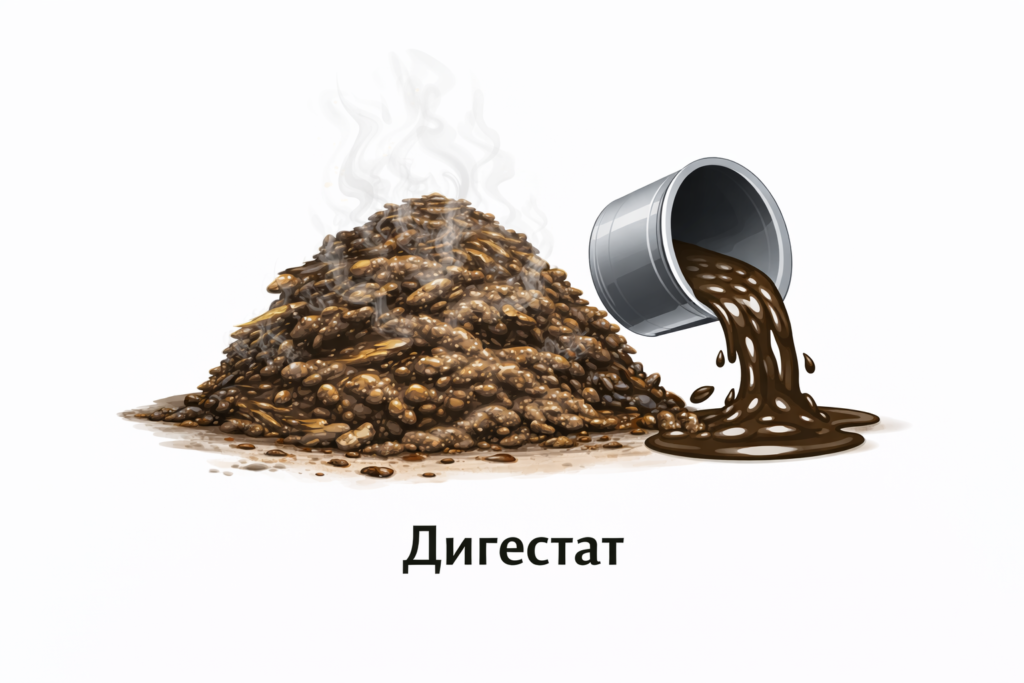
Digestate is formed as a result of microbiological decomposition of organic matter under anaerobic conditions and in its composition is a complex multicomponent system, including compounds of nitrogen, phosphorus, potassium, calcium, magnesium, sulfur, trace elements, humus-like substances, organic acids, amino acids and various biologically active metabolites. In addition to mineral nutrients, digestate contains compounds that are capable of exhibiting the properties of growth stimulants and regulators of physiological processes in plants, which makes it a potentially valuable agronomic resource.
However, the direct use of digestate in agriculture faces a number of limitations. First, the high moisture content leads to significant costs for transportation and application. Second, the liquid or pasty form complicates accurate dosing and uniform distribution over the field. Third, surface application increases the risks of nitrogen losses in the form of ammonia, leaching of nitrates into groundwater and secondary environmental pollution. In addition, many countries have environmental regulations that limit the rates and periods of application of organic fertilizers, which further narrows the possibilities of direct use of raw digestate.
In this regard, a significant amount of scientific work is devoted to finding ways to stabilize and transform digestate into forms more suitable for storage, transportation, and controlled use. One of the most promising directions is considered to be the combination of digestate with carbon and mineral matrices capable of adsorbing nutrients, reducing their mobility, and providing prolonged release.
Biochar, obtained by pyrolysis of biomass, attracts special attention as a universal carrier of nutrients and structure-forming agent. Its high specific surface area, developed porosity and significant cation exchange capacity create conditions for the retention of ammonium ions, phosphates and other nutrient forms, reducing their losses and increasing their availability for plants. In addition, biochar improves the water-holding capacity of the soil, reduces the bulk density, increases aeration and creates microniches for soil microorganisms.
In parallel with the development of biocarbon technologies, there is growing interest in natural silicon- and potassium-containing phyllosilicates (mainly glauconite) as alternative mineral components of fertilizers. Glauconite, which belongs to the group of layered silicates, is characterized by the presence of potassium in the crystal lattice and the ability to slowly release it into the soil environment. In addition to potassium, glauconite can serve as a source of silicon, iron, magnesium and a number of trace elements, and also exhibit buffer properties with respect to the reaction of the soil solution.
Despite the significant amount of research on digestate-biochar systems and the separate application of siliceous minerals in agriculture, their integration into a single biologically and structurally engineered granular composition remains fragmentarily studied. The vast majority of works consider these components as separate additives, rather than as elements of a single composite material with a predetermined architecture and functionality.
In this context, the development of the concept of a composite organo-mineral material, in which digestate acts as a nutritious organic matrix, biochar as a porous carbon framework, and glauconite as a mineral buffer with a prolonged release of potassium and trace elements, is relevant. This approach allows us to move from simple mixing of components to purposeful design of the granule as a functional system.
The purpose of this work is to form a scientifically based concept for creating a granular organo-mineral composite “digestate – biochar – glauconite”, determine the role of each component in the structure of the material, and outline the expected agronomic and environmental benefits of the proposed system.
The proposed concept considers three functionally different but complementary materials as starting components: the solid fraction of digestate, biochar, and glauconite (silicon- and potassium-containing phyllosilicate).
The resulting solid fraction of digestate usually contains 20–35% dry matter and is characterized by the presence of organic carbon, organically bound forms of nitrogen, phosphorus, as well as a significant amount of meso- and microelements. Before further use, it is advisable to subject the solid fraction to preliminary drying to a moisture content of 25–35%, which provides optimal rheological properties for mixing and granulation.
All three components may contain macro-, meso-, and microelements, as well as varying amounts of moisture, which must be taken into account when formulating the recipe and calculating mass ratios.
The ranges indicated are indicative and can be adjusted depending on the target characteristics of the final product, in particular the desired ratio of organic and mineral fractions, potassium content, carbon or sorption capacity of the granule. Thus, the formulation is considered flexible and adaptable to specific agronomic tasks.
The dried solid fraction of digestate, crushed biochar and potassium-containing silica powder are mixed in horizontal or planetary mixers until a homogeneous mass is achieved. If necessary, the humidity is corrected by adding process water or liquid fraction of digestate. The optimal humidity of the mixture before granulation should not exceed 25%, which ensures sufficient plasticity and the formation of stable agglomerates.
The proposed technological scheme can be implemented at laboratory (5–20 kg/batch), pilot (200–500 kg/batch) and industrial levels (>1 t/batch) using standard granulation equipment.
Granulation can be carried out in drum granulators or disc granulators, with possible spraying and rolling. The choice of equipment type depends on the required productivity, energy consumption and the desired granule diameter.
During the granulation process, biochar particles form an internal porous framework, on the surface of which organic components of the digestate and mineral particles of glauconite (silicon and potassium-containing phyllosilicate) are adsorbed, which leads to the gradual growth of the granule according to the “snowball” principle.
The formed granules are subjected to low-temperature drying (60–80 °C) to a residual moisture content of 8–12%, then cooled and sieved to separate non-standard fractions. Large particles can be crushed and returned to the process.
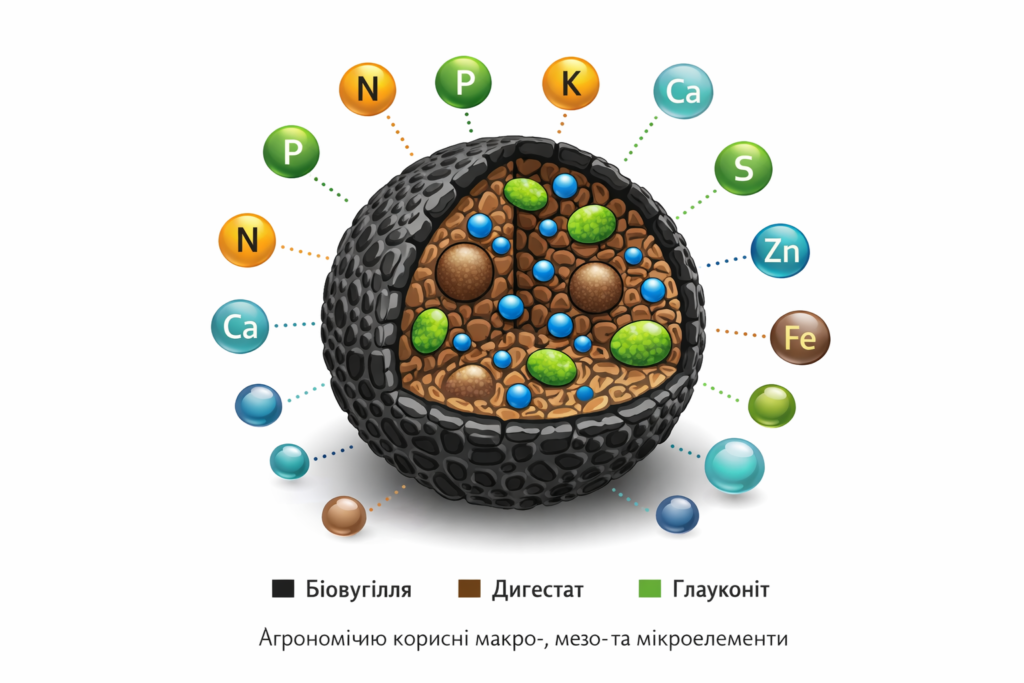
Synergistic granule based on digestate, biochar and silicon-containing mineral matrix forms not an inert carrier of nutrients, but a biologically active microenvironment suitable for the settlement, preservation and functioning of agronomically useful microorganisms. The porous structure of biochar acts as a physical framework in the pores of which microbial cells are fixed, form biofilms and receive protection from drying out, ultraviolet radiation and temperature fluctuations. The digestate in the granule serves as a nutritious organic matrix that provides microorganisms with available carbon, nitrogen and phosphorus, creating conditions for rapid activation of metabolism and stable growth.
Glauconite (a silicon- and potassium-containing phyllosilicate) additionally performs a buffer function, softening pH fluctuations, adsorbing nutrient cations and creating mineral surfaces for cell attachment. In such an environment, nitrogen-fixing, phosphate-mobilizing, potassium-mobilizing and cellulolytic microorganisms function effectively, converting organic and mineral compounds into forms available to plants. If the granule is additionally enriched with specially selected microbial consortia, it acquires the properties of a carrier of living systems and moves from the category of passive fertilizer to the category of bioactive material.
After being introduced into the soil, such a granule is moistened, microorganisms are activated and form a zone of increased biological activity around it, to which root growth is directed. As a result, the granule, which has already worked as a vehicle for beneficial microorganisms and substances, even with slow decomposition, works as a local biological node, gradually releasing nutrients, supporting the development of beneficial microflora and contributing to the formation of a stable, functionally active rhizosphere. This fundamentally distinguishes the proposed system from traditional fertilizers and makes it an important tool for regenerative and biologized agriculture.
The proposed composite based on Digestate is considered not only as a source of nutrients, but also as a tool for the targeted formation of a functionally active soil biocenosis. The expected results relate to the physical, chemical, biological and biogeochemical processes occurring in the soil after the introduction of granular material.
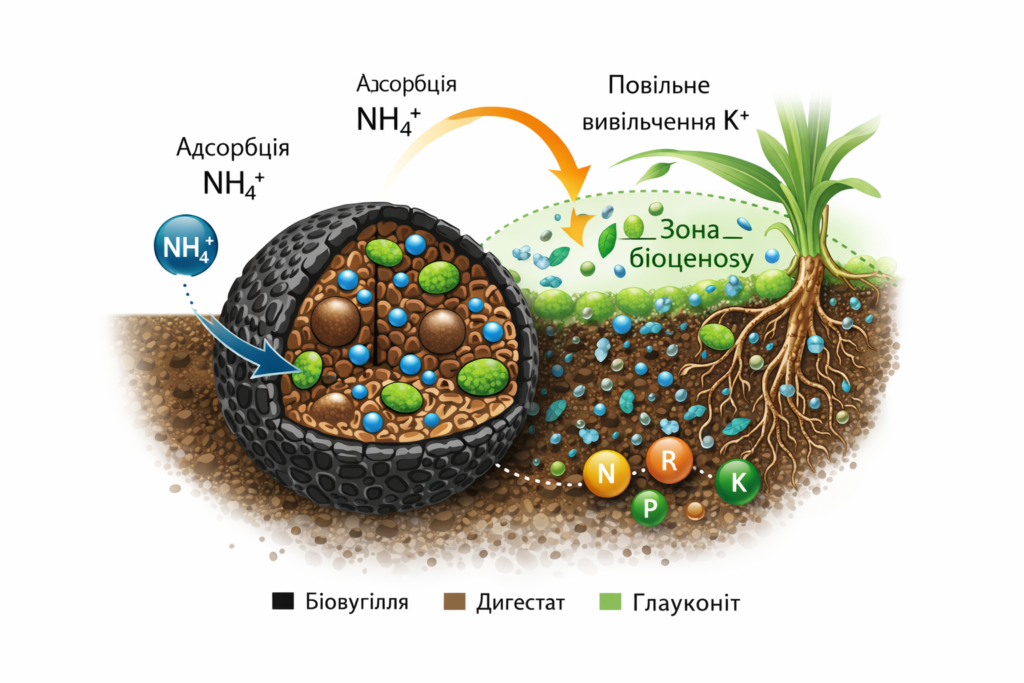
One of the key problems of organic fertilizers is nitrogen losses due to ammonia volatilization, denitrification and nitrate leaching. In the proposed system, biochar and silicon matrix act as a sorption buffer capable of retaining ammonium ions in their micro- and mesopores. This creates conditions for temporary nitrogen fixation with subsequent gradual release into the soil solution.
This sorption-buffering effect is expected to reduce peak mineral nitrogen concentrations after fertilizer application, reduce gaseous losses, and limit nitrate migration to lower soil horizons. Ultimately, this should lead to an increase in plant nitrogen utilization and more stable nutrition throughout the growing season.
Glauconite (a silicon and potassium-containing phyllosilicate) integrated into the granule structure also contains potassium in the crystal lattice, which causes its slow release. Unlike water-soluble potassium salts, this mechanism ensures a more uniform supply of potassium to the root zone and reduces the risk of its leaching.
In addition to potassium, it is expected to receive silicon, iron, magnesium and a number of trace elements that participate in the formation of cell wall strength, photosynthetic processes and anti-stress resistance of plants. The mineral phase of silica also performs a buffer function regarding the reaction of the soil environment, stabilizing the pH in the granule zone.
Biochar, silicon and organic matrix of digestate contribute to the formation of water-resistant aggregates, reducing the density of the soil and increasing its porosity. Water-holding capacity increases, infiltration and aeration improve, which creates favorable conditions for the development of root systems.
Improving soil structure is directly related to reducing erosion processes, increasing resistance to compaction, and overall increasing the agrophysical quality of the soil profile.
The central expected result is the intensification of the development of soil biocenosis – a collection of microorganisms, fungi, microfauna and their trophic relationships.
The porous structure of biochar creates microniches in which microorganisms are protected from sudden fluctuations in humidity, temperature and chemical composition. The organic matter of the digestate acts as a source of energy and carbon, and the mineral surfaces of glauconite provide additional adsorption and ion exchange zones.
The number of nitrogen-fixing, phosphate-mobilizing, potassium-mobilizing and cellulolytic microorganisms increases, which leads to a more active transformation of nutrients into forms available to plants. Thus, the granule acts not only as a source of nutrients, but also as an incubator of soil life, which launches self-sustaining biological cycles.
Biochar is a relatively inert form of carbon with a long residence time in the soil. Its integration into granular fertilizer contributes to the formation of long-lasting pools of organic carbon and reduces CO₂ emissions per unit of production.
It is expected that the use of the composite will help increase the potential of soils to sequester carbon, which makes the technology attractive from the standpoint of participation in carbon credit programs and climate-smart agriculture.
Taken together, the above processes should manifest themselves in the form of more stable plant growth, increased efficiency of nutrient use, increased yield and improved product quality. At the same time, the key long-term result is not only the harvest, but the restoration and growth of functional soil biocenosis as the basis of fertility.
The proposed composite “digestate – biochar – glauconite (silicon and potassium-containing phyllosilicate)” should be considered not as a mechanical mixture of components, but as a biologically and structurally designed system in which each element performs a clearly defined function and simultaneously enhances the action of others. This approach corresponds to the modern paradigm of materials science in agronomy, where the key object is not a separate substance, but the functional architecture of the composite.
Biochar forms the physical “skeleton” of the granule, its micro- and mesoporous structure providing a large internal surface area on which nutrient ions, organic molecules and water can be adsorbed. This creates a zone of local concentration of resources available to plant roots and microorganisms inside the granule.
In addition to its sorption function, biochar acts as a stabilizer of the physical form of the granule, reducing its fragility and susceptibility to breakage during transportation and application. At the same time, it acts as a long-term source of stable organic carbon that supports the development of heterotrophic microbiota.
The digestate in the composite structure acts as an organic matrix that fills the pores of the biochar and binds the mineral particles of glauconite. It contains both readily available mineral forms of nutrients and organically bound compounds that gradually mineralize in the soil.
This dual nature of digestate allows for a quick start-up effect of nutrition with a prolonged supply of elements throughout the growing season. In addition, the organic acids and humic compounds of digestate can chelate trace elements, increasing their availability to plants.
Glauconite (a silicon- and potassium-containing phyllosilicate) acts as a mineral buffer integrated into a carbon-organic matrix, where potassium bound in the mineral’s crystal lattice is released gradually through ion exchange and weathering, providing long-term potassium supply without peak concentrations.
Additionally, silicon, iron, magnesium and trace elements are supplied, which participate in the structural formation of plant tissues, photosynthesis and stress resistance. The surfaces of mineral particles serve as adsorption sites for organic molecules and microbial cells, which enhances the stability of the biocenosis.
The key difference between the proposed system and traditional fertilizers is the transition from the concept of a “nutrient carrier” to the concept of a “bioactive platform.” A microenvironment is formed inside the granule, in which:
This creates the prerequisites for the colonization of the pellet by agronomically beneficial microorganisms and the formation of local microbial consortia that participate in the cycling of nitrogen, phosphorus, potassium, and carbon.
At the same time, if the composite is additionally enriched with specially selected microbial cultures (nitrogen fixers, phosphate mobilizers, cellulolytics, PGPR bacteria), the granule performs the function of a carrier of living microorganisms. In this case, the fertilizer moves into the category of bioorgano-mineral materials with controlled biological activity.
Thus, the digestate composite integrates a complex of functions within a single granule:
It is this integration that fundamentally distinguishes the proposed system from traditional organic, mineral, and organo-mineral fertilizers and determines its prospects for regenerative and biologized agricultural systems.
Within the framework of the presented work, a scientifically based concept for the creation of a biologically and structurally designed organo-mineral composite based on digestate, biochar and silica, intended for use as a granular fertilizer in sustainable and regenerative agriculture systems, has been formed, partially tested and confirmed. The proposed approach is based on the combination of organic, carbon and mineral components within a single functional granule architecture.
It has been shown that each component of the composite performs not an isolated, but a complementary role: digestate provides a nutritious organic matrix and an energy source for soil microbiota; biochar forms a porous carbon framework with high sorption capacity and long-term stability; glauconite functions as a mineral buffer and a source of prolonged potassium, silicon and trace elements. Their synergy creates the prerequisites for the controlled release of nutrients, reducing nitrogen and potassium losses and increasing the efficiency of plant nutrition.
A fundamentally important result is the shift in focus from fertilizer as a passive carrier of nutrients to fertilizer as a bioactive platform capable of forming and maintaining a functionally active soil biocenosis. In such a system, the granule acts as a microenvironment where carbon, organic and mineral resources are combined, which stimulates the development of agronomically beneficial microorganisms and the launch of self-sustaining biogeochemical cycles in the soil.
An additional level of functionalization of the composite is the possibility of its targeted enrichment with a consortium of agronomically useful microorganisms, in particular representatives of the genera Azotobacter, Acetobacter, Bacillus, Paenibacillus, Oceanobacillus, Pseudomonas, Streptomyces, Virgibacillus, Lactobacillus, Clostridium. It is expected that such microbial consortia will provide effective stimulation of the development of the plant root system, increase the availability of elements N, P, K, Ca, S, Zn, Fe, as well as accelerate the mineralization of nutrient residues and the transformation of organic forms of elements into compounds available to plants.
The proposed approach is one of the most illustrative examples of the implementation of the principles of the circular economy, in which food and agricultural waste is transformed into high-value products for agriculture through biogas and thermochemical processes, and ultimately back into food products. Such a closed cycle not only minimizes resource losses, but also contributes to the restoration of soil fertility, the accumulation of stable organic carbon and the increase of the ecological sustainability of agricultural landscapes.
Thus, the digestate-biochar composite on a silicon-containing mineral matrix should be considered as a multifunctional living organo-mineral material that integrates within a single granule the functions of plant nutrition, soil conditioning, mineral buffering, and soil microbiota support. It is this integration that determines its prospects for regenerative and biologized agricultural systems.
Further research should be aimed at laboratory and field validation of the proposed concept, optimization of the formulation depending on the type of soil and crops, as well as assessment of the long-term impact on soil biocenosis, nutrient balance, and yield indicators.
Greening agro is not a fad, but a reaction to the fact that excess nutrients are becoming a source of soil and water pollution, and biodiversity loss.

Digestate with biochar and glauconite is an innovative organo-mineral composite for reducing nutrient losses, prolonged plant nutrition, and increasing soil fertility.

Soil degradation and water pollution are increasingly merging into a combined environmental crisis, especially in arid and post-industrial regions.


