Integrated soil-water-biotechnology system for arid and post-industrial landscapes (using the example of Kazakhstan)
Restoring soil fertility through water restoration: An integrated soil-water-biotechnology system for arid and post-industrial landscapes (using the example of Kazakhstan)
Soil degradation and water pollution are increasingly merging into a combined environmental crisis, especially in arid and post-industrial regions. This article presents an integrated soil-water-biotechnology system that links waterbody restoration with soil fertility restoration through the controlled reuse of mined sediments activated by microbial consortia and biosurfactants. This approach combines physical rehabilitation of waterbodies with biological soil activation using indigenous hydrocarbon-degrading microorganisms, rhamnolipid biosurfactants, calcium peroxide, and phytoremediation crops.
Based on field-proven bioremediation experiments and ecosystem-scale soil and water management concepts, we demonstrate how sediments, traditionally considered waste, can become a regenerative resource for soil restoration. The system is evaluated for Kazakhstan, where aridification, salinization, and oil-related soil contamination coincide with extensive watershed degradation.
Results from long-term bioremediation studies show that the integrated use of microorganisms, biosurfactants, plants, and oxidants reduced oil contamination from 9.5% to 1.3–1.6%, increased soil dehydrogenase activity by up to 2.7 times, and reduced phytotoxicity by more than 3.5 times. These results support the viability of combining sediment management with soil biological restoration to create a cyclic soil–water restoration cycle.
The proposed model provides a scalable pathway for climate-resilient agriculture, land reclamation, and water security in Kazakhstan and similar regions.
1. Introduction
Land degradation and freshwater degradation are no longer separate environmental problems. On a global scale, agriculture, water management and soil health form a closely linked system in which degradation in one component spreads instability in the others. In arid and semi-arid regions, this link is exacerbated by climate change, dependence on irrigation, salinization and industrial pollution.
Kazakhstan is a critical example. Large-scale irrigation, oil extraction, reservoir siltation, and soil salinization have created overlapping pathways of degradation that threaten food security and ecosystem stability. Traditional responses—reservoir dredging, sediment disposal, chemical soil remediation—remain fragmented and often ecologically counterproductive.
Recent advances in environmental biotechnology show that bottom sediments, when biologically activated, can serve as valuable soil conditioners rather than waste. At the same time, biosurfactants and microbial consortia significantly increase the bioavailability of pollutants and the cooperation between plants and microbes.
This article proposes a single model for soil and water regeneration that integrates:
restoration of the reservoir,
biotechnological activation of sludge,
biological soil restoration,
stabilization caused by phytoremediation.
2. Scientific foundations of biological regeneration of soil and water
2.1 Biosurfactants as soil and water mediators
Rhamnolipid biosurfactants increase the solubility of hydrophobic contaminants, reduce surface tension, and facilitate microbial access to contaminants. Their dual function is particularly important in sedimentary soils, where hydrocarbons and stable organic compounds remain tightly bound to mineral particles.
Controlled experiments have demonstrated that pre-sowing treatment of plants with rhamnolipid biosurfactants reduces oxidative stress (H₂O₂ and malondialdehyde) in plants grown on oil-contaminated soils, increasing physiological resistance and root development.
Use of biosurfactants.
2.2 Microbial consortia and soil metabolism restoration
Autochthonous microbial consortia based on Rhodococcus and Gordonia species demonstrated strong hydrocarbon degradation capacity. In combination with biosurfactants and calcium peroxide, soil dehydrogenase activity increased up to 2.7-fold, reflecting the reactivation of soil metabolism and carbon cycling. Use of biosurfactants.
2.3 Phytoremediation as a structural stabilizer
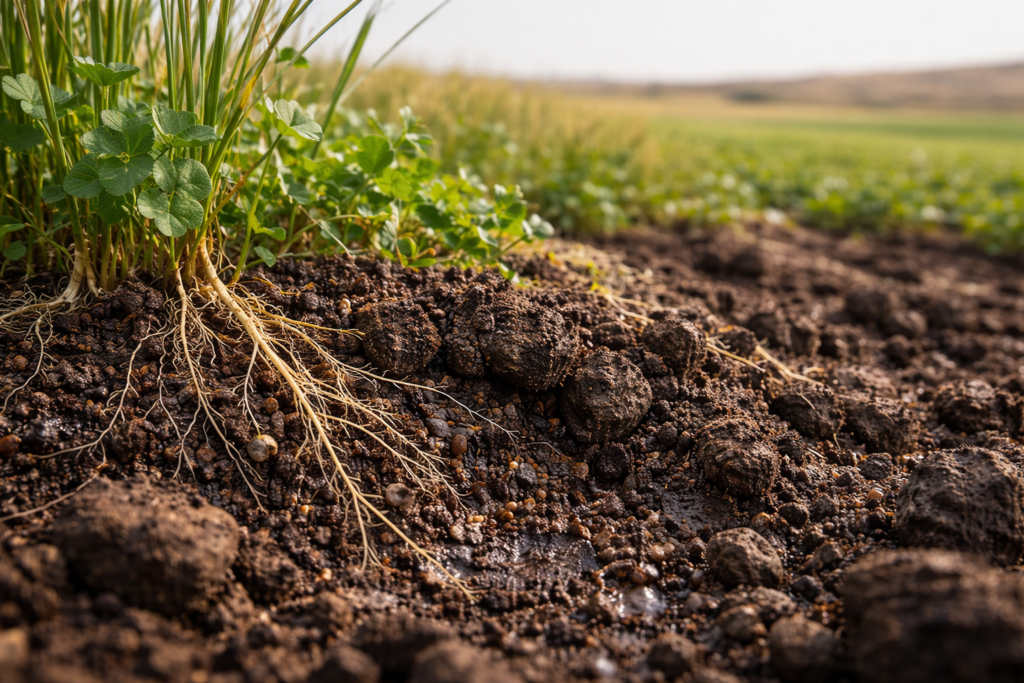
Field peas and sorghum functioned as rhizosphere bioreactors. Root exudates fed microbial populations, creating a positive feedback loop: plants stimulated microbes, microbes detoxified the soil, which in turn improved plant growth.
3. From reservoir to soil: sediment-based regeneration cycle
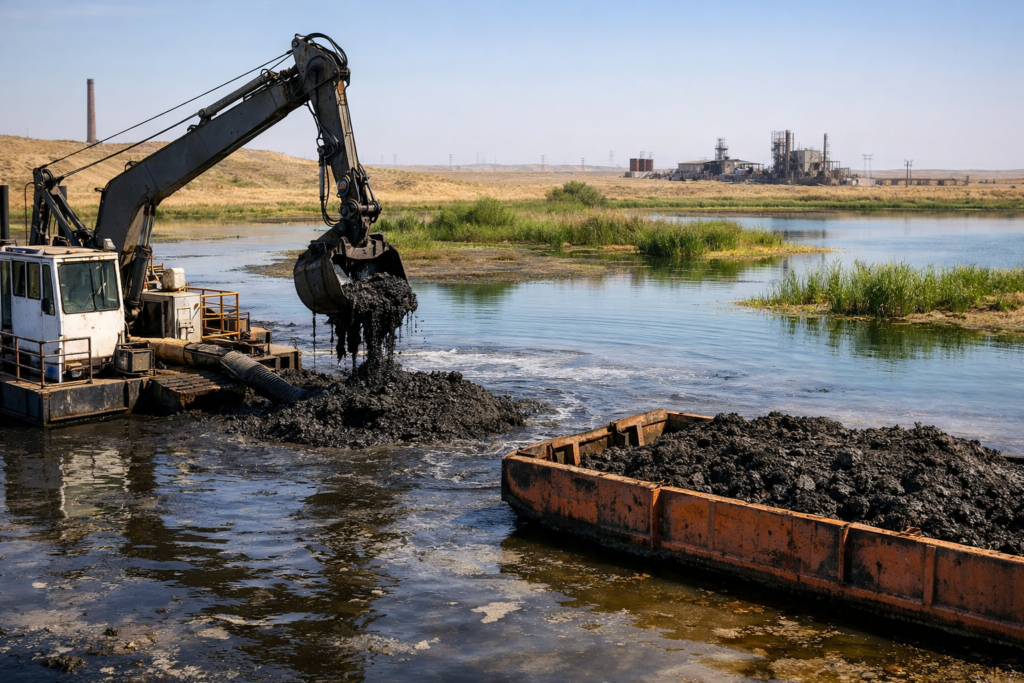
Traditional reservoir dredging removes silt and stores it as waste. Instead, the proposed system treats sediment as a biogeochemical carrier of organic matter, silicon, nutrients, and microbiota.
After environmental screening, the sediments undergo:
biological activation (microbial consortia),
treatment with biosurfactants (desorption of pollutants),
oxidative stabilization (CaO₂).
The processed material becomes a substrate for soil restoration, which is applied to degraded lands, closing the water-sediment-soil cycle.
4. Relevance for Kazakhstan
Kazakhstan faces:
aridification and salinity caused by evaporation,
reservoirs filled with sedimentary rocks,
oil-contaminated lands around mining areas,
a decrease in soil biological activity.
The proposed system allows Kazakhstan to:
rehabilitate reservoirs and canals,
convert mined materials into soil resources,
biologically detoxify oil-affected lands,
restore the fertility of pastures and agricultural lands.
Unlike mineral-chemical reclamation, this model creates living soils rather than chemically adjusted substrates.
5. Environmental and economic consequences
The cost of bioremediation ranges from US$5 to US$300 per m³, compared to US$600–2000 for thermal or incineration methods.
By reusing sludge in agriculture, the costs of restoration are converted into increased productivity.
Additional benefits include:
carbon sequestration through soil organic matter restoration,
reducing nutrient runoff into water bodies,
increasing drought resistance,
development of a circular bioeconomy.
6. Conclusions
The integration of water body restoration, sediment reuse, biosurfactants, microbial consortia, and phytoremediation creates a self-reinforcing system for soil and water regeneration. Experimental data confirm that this approach can detoxify soils, reactivate biological activity, and restore productivity at the ecosystem scale.
For Kazakhstan, this framework offers a strategic path to unify water security, land restoration, and climate-resilient agriculture into a single science-based model.
7. Institutional perspective and international scaling
The Institute of Nanotechnology and Organic Products “AVELIFE” (Ukraine) declares its strategic interest in expanding its soil-water-biotechnology platforms beyond national borders to contribute to global environmental stabilization and restoration of the land-water system.
AVELIFE has developed and tested a portfolio of biologically-based remediation technologies that integrate microbial consortia, biosurfactants, mineral-organic carriers, and ecosystem-based land management. These technologies are not designed as isolated products, but as modular components of regenerative systems that adapt to diverse climatic, pedological, and hydrological conditions.
The Institute considers Kazakhstan as a priority partner country due to the combination of aridification, land degradation, industrial soil pollution and sedimentation of water bodies. The deployment of AVELIFE technologies in Kazakhstan is envisaged through:
joint pilot projects on the activation of sediment in reservoirs and canals,
field demonstration of the reuse of biologically activated sludge for soil restoration,
joint research with national scientific institutions,
training programs for local specialists in biotechnological land restoration.
Beyond Kazakhstan, AVELIFE positions this framework as a transferable model for Central Asia, Eastern Europe, the Middle East, and other regions facing related land and water degradation.
By expanding its technological presence internationally, the Institute seeks to participate in shaping a new generation of environmental solutions focused on biological regeneration rather than chemical compensation, thereby contributing to the long-term correction of the global ecological trajectory.
Tymur Lyevda¹, Andriy Banya², Olena Karpenko³
¹ Institute of Nanotechnologies and Organic Products AVELIFE, Ukraine
² Institute of Physical-Organic Chemistry and Coal Chemistry, NAS of Ukraine
Introduction Among the promising and ecologically acceptable methods of environmental restoration, priority is given to biological approaches (bioremediation, phytoremediation), i.e., the purification of soils and…