

Introducing “microbiome + silicon”
A practical approach to implementing solutions at the interface of soil microbiome and silicon: diagnostics, field validation, common mistakes, and limits of expectations.


The idea of combining the work of the soil microbiome and silicon nutrition sounds attractive. Less stress for the plant, a more stable system, better resource efficiency. But there is an important line between agronomy and beautiful theory. In practice, this combination does not work like a button. It is not started by one product and does not have a universal scheme for all crops, soils and farms. Today, it is more correct to talk not about “ready-made technology”, but about a direction that requires field adaptation and verification.
The worst-case scenario is to buy a biopreparation or silicon fertilizer and wait for the “synergy” to appear by itself.
The first step is to evaluate the initial state of the field:
It is more accurate to speak not of “dead soil,” but of a specific type of soil with low biological activity, poor structure, or a deficiency of organic matter. In such conditions, any microbial or mineral solutions will work less predictably.
The soil microbiome is not a single “beneficial bacterium” on the label, but a complex living community of microorganisms that participates in the decomposition of organic matter, the cycling of nutrients, the formation of the rhizosphere and the interaction with the plant root system. That is why working with the microbiome is not only about introducing inoculants, but first of all, creating conditions in which this community can establish itself, develop and function stably.
In this context, the action of complex preparations, such as GREENODIN, is important, which consists not only in introducing individual nutritional or biologically active components, but also in creating a more balanced environment for soil life.
The organic part can serve as a source of carbon and energy for microbial processes, the mineral part as a source and buffer of nutrients, and the porous structured matrix as a space for moisture retention, adsorption of compounds, and formation of an active zone around the root. As a result, not only the presence of microorganisms is enhanced, but also their functional role in the soil.
Therefore, the microbiome has the greatest effect not by itself, but when the agrosystem supports its development: through organic matter, available moisture, moderately stable environmental reaction, mineral base and conditions for an active rhizosphere. It is this approach that more accurately describes the creation of a soil ecosystem than the simplified formula “add microbes – get a crop”.
What is known about silicon?
At the same time, the modern understanding of its role is broader: silicon can affect the plant not only directly, but also indirectly – by changing the properties of the soil environment, moisture regime, the availability of individual nutrients, the nature of root secretions, and even the structure of microbial communities.
For example, in the GREENODIN and AVELIFE systems, silicon should be considered not as a “magical individual factor”, but as part of a complex action. Provided it has the appropriate form, dispersion and combination with an organic and mineral matrix, it can work as a functional component of the environment:
For the plant, this can mean better adaptation to stress, stronger tissues, and more effective interaction with soil biota.
But scientific caution is important here. The effects of silicon are not universal and the same under all conditions. They depend on the shape and size of silicon particles, crop, soil type, initial agrochemical state, stress level and the entire cultivation technology. Therefore, it is more correct to say not “silicon automatically strengthens the microbiome”, but that as part of a properly formed organo-mineral-biological system it can be an important element that helps the soil and the plant work more harmoniously and sustainably
The “microbiome + silicon + organo-mineral base” approach does not work as a separate magic supplement. It gives results when integrated into the overall system of soil restoration and maintenance. This is how it makes sense to consider solutions based on GREENODIN and the bioactive approaches of AVELIFE:
not as a one-time “injection of effect”, but as tools for forming a more vibrant, sustainable and productive agroecosystem.
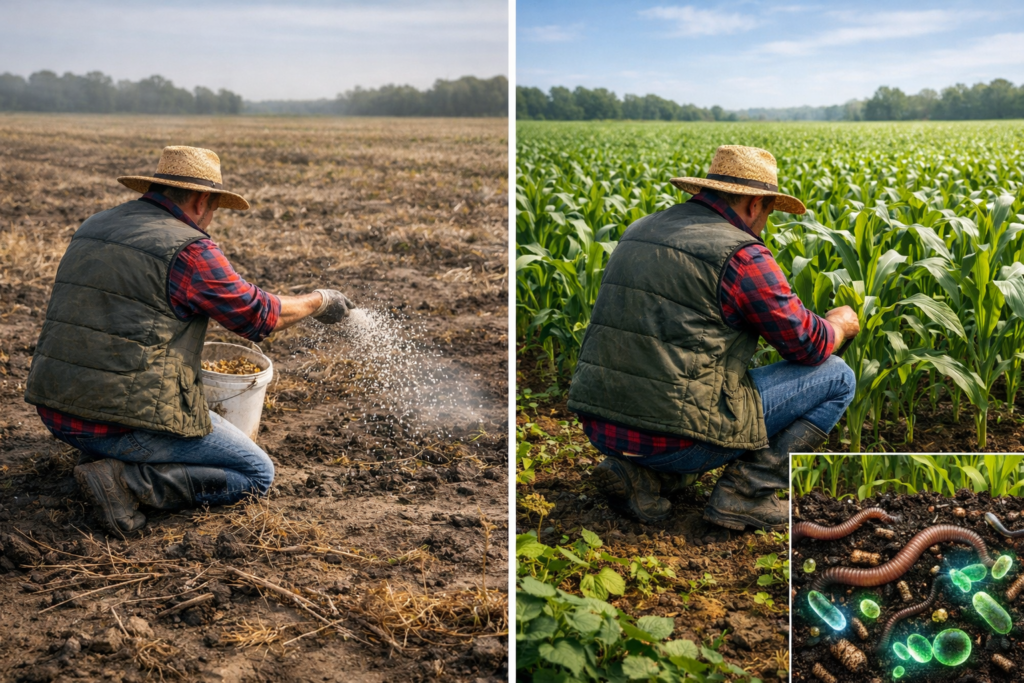
Before launching any biologization, it is necessary to determine what exactly is inhibiting the development of soil life and root activity.
Practical sense: if the soil is compacted, overdried, poor in organic matter and constantly under stress, no microbial product will show full effect.
If the field has a weakened structure, low moisture capacity, and an unstable rhizosphere, it is advisable to start not with a “point bacterium,” but with the introduction of an organo-mineral composition, which simultaneously works to improve the physical properties of the soil, retain moisture, buffer elements, and create an environment for the development of beneficial microbiota.
AVELIFE bioactive solutions in such a scheme are appropriate as an amplifier of the living part of the system, and not as an attempt to compensate for a degraded environment.
The microbiome does not exist “in the air.” For its stable operation, it requires:
Without this, inoculation often produces a short or unstable effect.
Practical meaning: microorganisms work where there is something to decompose, where there is moisture, where there is a surface for attachment, and where the root can form an active rhizosphere.
Example in GREENODIN logic:
The organic part of the composition creates a base for microbial processes, the mineral part acts as a carrier and reserve of elements, and the structured matrix helps retain water and nutrients in the root zone. This means that the microbiome receives not only a “subpopulation”, but also an environment for functioning.
Example in AVELIFE logic:
Bioactivators and microbial complexes are appropriate to use where there is already an organic substrate, root activity and basic soil stability. In this case, they can enhance the natural processes of mineralization, element mobilization and rhizosphere healing.

Biopreparations, compost extracts, microbial inoculants or bioactivators should not be considered a replacement for basic agronomy. They should be used as part of a systemic solution.
Practical sense: a biological product works better when the soil is able to “accept” it, rather than when it is added to a depleted system in the hope of a miracle.
Example of an integrated approach:
The GREENODIN organic-mineral block can act as a basis that creates the environment, and the AVELIFE solution can act as a biological reinforcement aimed at activating microbiological and rhizosphere processes. In such a combination, one component does not duplicate the other, but supports it.
Silicon is not a stand-alone solution. It is advisable to use it as an element that supports the plant and the soil environment, especially under stressful conditions.
It is important to consider:
Practical meaning: in some conditions, silicon can improve plant resistance, water regime, and root activity, while in others its effect will be weak or secondary.
Example in GREENODIN logic:
Silicon in a complex organo-mineral system should be considered as a functional component that helps to form a more stable environment around the root, support plant tissues, participate in water balance and indirectly influence rhizosphere processes. Its strength is not in isolated application, but in combination with the organic matrix, mineral base and microbiological activity.

The same scheme may work differently on light and heavy soils, in dry and wet seasons, on vegetables, grains or berries. Therefore, the final application model must be built taking into account local data.
What to consider:
For fields with signs of drying out and structural degradation, the emphasis can be placed on an organo-mineral base that improves moisture retention and the rhizosphere. For systems with sufficient organic matter but weakened biological activity, on strengthening with AVELIFE bioactivators. For stressful seasons, on schemes where silicon and microbial-organic support work together.
Talking about synergy only makes sense when it is confirmed by observations and figures. It is necessary to evaluate not only the general impression of the field, but also specific indicators.
What to track:
Example of a field approach:
Then you can evaluate not a “beautiful story,” but the real contribution of each element: to plant resistance, root development, stress response, and the ultimate economy.
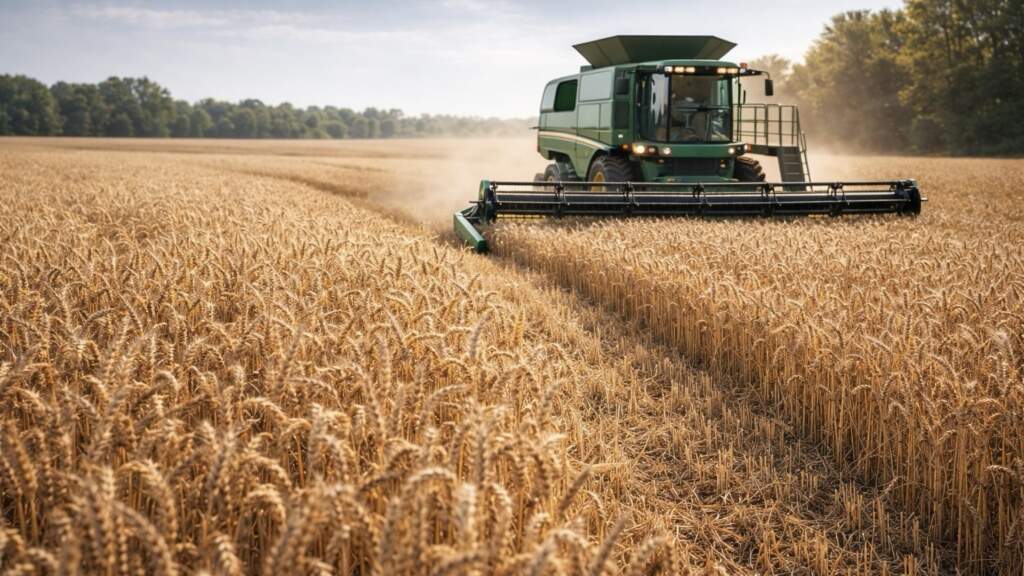
The working scheme without magic looks like this: first we remove the causes of degradation, then we create a resource base for soil life, then we introduce an organic-mineral base, reinforce it with biological solutions where there are conditions for this, and be sure to check the result in the field.
Most often, farms are mistaken not in the idea itself, but in expectations:
“microbiome + silicon” is not a ready-made recipe, but an agronomic hypothesis that needs to be tested in the conditions of a specific farm.
Combining work with the soil microbiome and silicon can be a promising direction for more sustainable agricultural systems. But this combination does not work according to the logic of “added two products – got self-regulation”. It requires diagnostics, adaptation of technology, control plots and honest assessment of the result. In a strong text, this should be talked about in this way: not as a new standard for everyone, but as a direction that can give an effect under certain conditions and with competent implementation.
A practical approach to implementing solutions at the interface of soil microbiome and silicon: diagnostics, field validation, common mistakes, and limits of expectations.

Learn how silicon and the soil microbiome interact to create a stable system for organic farming.

What are magnesian-organomineral materials, what is their potential for road construction, and why it is not worth promising “minus CO₂” without LCA.


