


Thermal depolarization of waste and energy efficiency ERVO
Technical analysis of depolarization (TDP) in an ERVO stack. Economics of organic waste processing and EROEI indicators. Expert assessment by Oleksandr Mospanenko.


Modern road construction is increasingly being evaluated not only by strength and cost, but also by carbon footprint, resource intensity and the possibility of reusing materials. It is in this context that interest in magnesian-organomineral systems is growing – composites based on magnesium binders with mineral and, in some solutions, organic components. But it is important not to oversimplify: such materials cannot be automatically called an “ecological replacement for concrete or asphalt” without analyzing the specific formulation, raw materials and the full life cycle. At best, this is a promising class of materials that can reduce the carbon footprint in some scenarios.
The reason is obvious: the cement and concrete sector remains a large source of CO₂ emissions, and international road and construction strategies are increasingly putting pressure on reducing the carbon intensity of materials.
The IEA directly indicates that the cement and concrete industries need to accelerate decarbonization, and current progress is still insufficient for a net zero trajectory.
It is against this background that systems are of interest where:
This is a general name for composite systems where magnesium compounds, in particular MgO, play the role of a binder or active component, and the structure is formed together with mineral fillers and, depending on the task, organic modifiers. In simple words: this is not one specific material, but a group of solutions where attempts are made to change the properties of the mixture, its resource base and potential environmental profile.
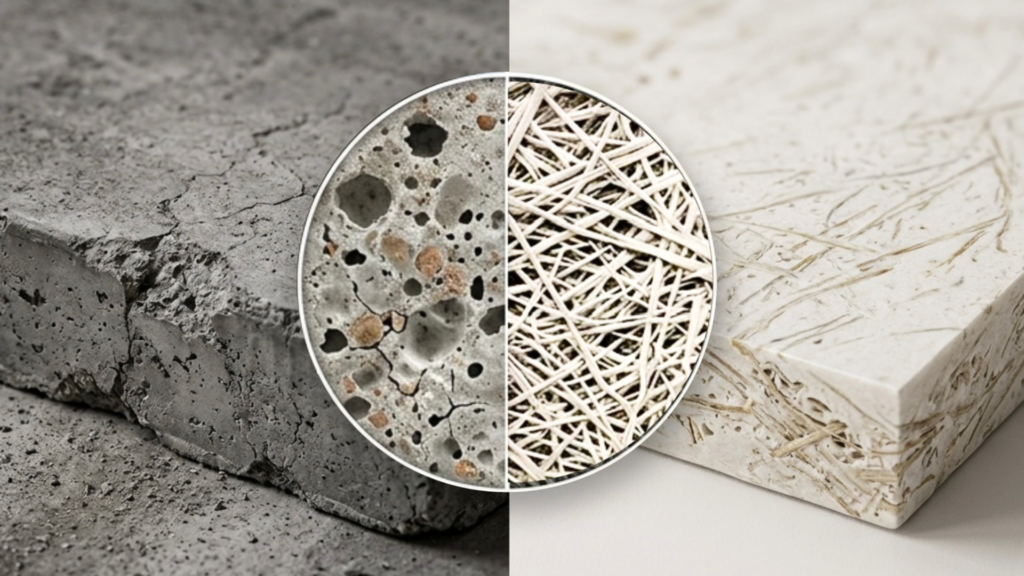
For some magnesia systems, the temperature of obtaining the active phase may be lower than in the case of Portland cement clinker production. But this does not automatically mean a lower carbon footprint: it all depends on the source of raw materials, energy, transport and processing technology.
Such systems may be compatible with some industrial mineral waste or secondary aggregates. This makes them interesting in the context of circular approaches. But here too, caution is needed: compatibility does not automatically equal economic or engineering feasibility.
Some MgO-containing solutions may interact with CO₂ during hardening or subsequent operation. However, the scale of this effect strongly depends on the chemistry of the system and environmental conditions. The thesis “the material compensates for emissions” without LCA calculation is too bold. It is more correct to say: individual formulations can partially bind CO₂, but the real climate effect must be proven separately.
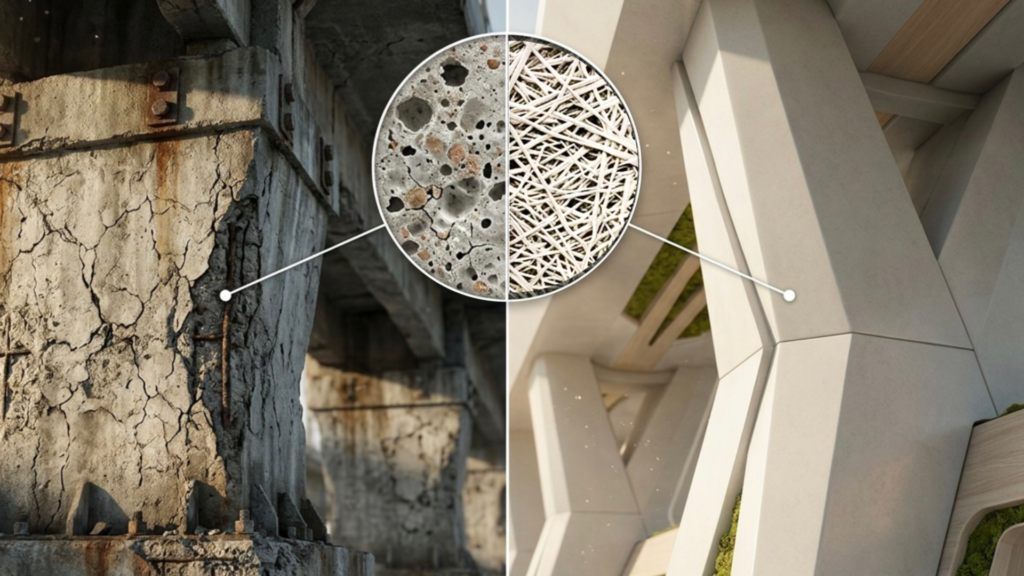
The most cautious and professional approach is to consider such materials not as an immediate replacement for all traditional road solutions, but as a prospect for individual applications:
the technology is actively researched and has practical niches, but needs further validation and standardization
Without a full life cycle analysis, it is not possible to claim that any magnesia road material is “better for the climate” than concrete or asphalt.
Road material also includes durability, behavior in real climates, humidity, load cycles, maintainability, standards, and cost.
For a technology to become a market, rather than a series of isolated cases, repeatable formulations, technical requirements, and proven field behavior are required.
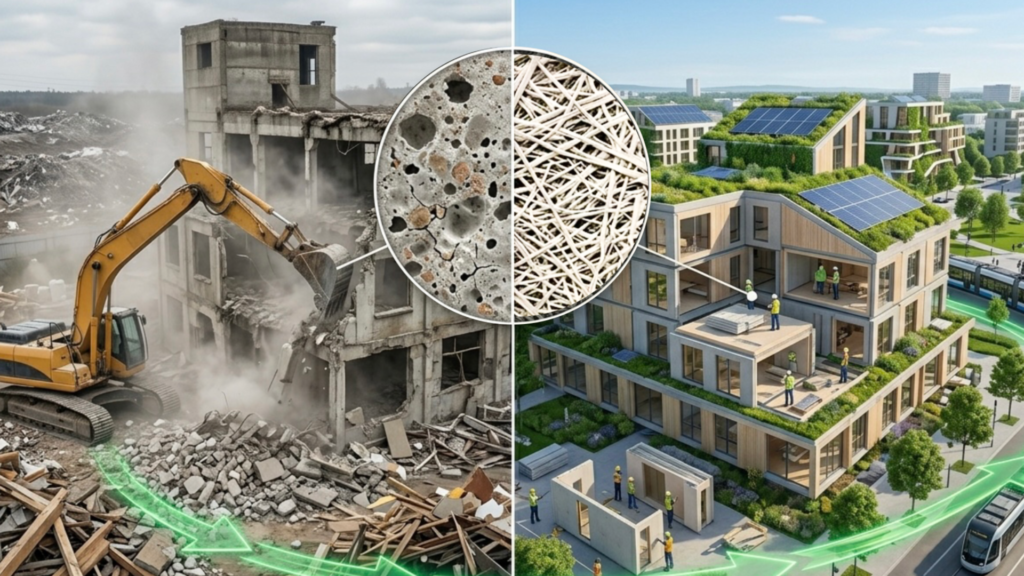
Despite the limitations, the interest in such materials is logical. Decarbonization of infrastructure, resource scarcity, rising raw material costs, and pressure to reuse waste are pushing the industry to look for alternatives. Therefore, magnesium-organic mineral systems are not a “ready-made answer to everything,” but one of the areas where useful solutions for low-carbon infrastructure may appear.
Magnesium-organic materials are interesting not because they have already proven their unconditional superiority over traditional road solutions, but because they open up a different set of possibilities: working with alternative raw materials, potentially lower carbon intensity in some scenarios, and better integration into circular models. But a strong text about them should sound honest: not “roads that reduce CO₂”, but “materials that can help reduce the carbon footprint of individual infrastructure solutions under certain conditions and after a full feasibility and LCA assessment”.
Technical analysis of depolarization (TDP) in an ERVO stack. Economics of organic waste processing and EROEI indicators. Expert assessment by Oleksandr Mospanenko.

Resistance analysis of ESKAPE strains.. Methodology by A. Demchenko for C-level Pharma.

Scientific justification for the reclamation of technozems. Bioremediation based on glauconite according to patents of the AVELIFE Institute. Expert assessment by Timur Levda for agricultural holdings