


Magnesium-organomineral materials: potential for roads
What are magnesian-organomineral materials, what is their potential for road construction, and why it is not worth promising “minus CO₂” without LCA.


A previous publication on our institute’s website shows that the problem of digestate accumulation in the European Union is systemic (see the previous AVELIFE publication Digestate in the EU: from the problem of accumulation to a managed agricultural resource) and requires a deep technological transformation, in particular through thermal conversion and biochar production. However, pyrolysis is only one of the directions for converting digestate into a managed agricultural resource. Another, no less important and more rapidly scalable solution is sorption stabilization with subsequent granulation.
Modern scientific publications confirm that the key problem of digestate is not its nutritional value, but its high nitrogen mobility, logistical complexity, and regulatory restrictions. That is why the focus of research in recent years has been on technologies for binding nutrients into stable matrices and forming controlled forms of fertilizers.
A review by Chojnacka et al. (Biomass and Bioenergy) shows that sorption and composite approaches to digestate processing are one of the key areas of its technological valorization under the conditions of the EU Nitrates Directive. The authors emphasize that the combination of the organic phase of digestate with mineral and carbon carriers allows to simultaneously reduce nitrogen losses and increase the agronomic efficiency of the product.
Similar conclusions are given in the review papers of Senevirathne et al. (Agronomy, MDPI), where it is noted that composite systems based on digestate, biochar and mineral components have significantly better stability indicators than traditional organic fertilizers. The role of porous materials in the formation of slow release of nutrients is especially emphasized.
A number of studies on biochar as a component of slow-release fertilizers (Wang et al., Environmental Science & Ecotechnology) have shown that the carbon matrix effectively adsorbs ammonium nitrogen, potassium, and phosphorus, but its efficiency increases significantly when combined with mineral sorbents.
It is this approach that underlies AVELIFE technological solutions, where biochar obtained from organic raw materials or digestate is combined with silica-containing materials that:
In process studies by Yu et al. (Sustainability, MDPI), it has been shown that granular composites based on digestate and biochar have significantly better slow-release characteristics of nutrients, especially when moisture content and granulometry are properly selected. The addition of mineral phases further improves the repeatability and stability of the product.
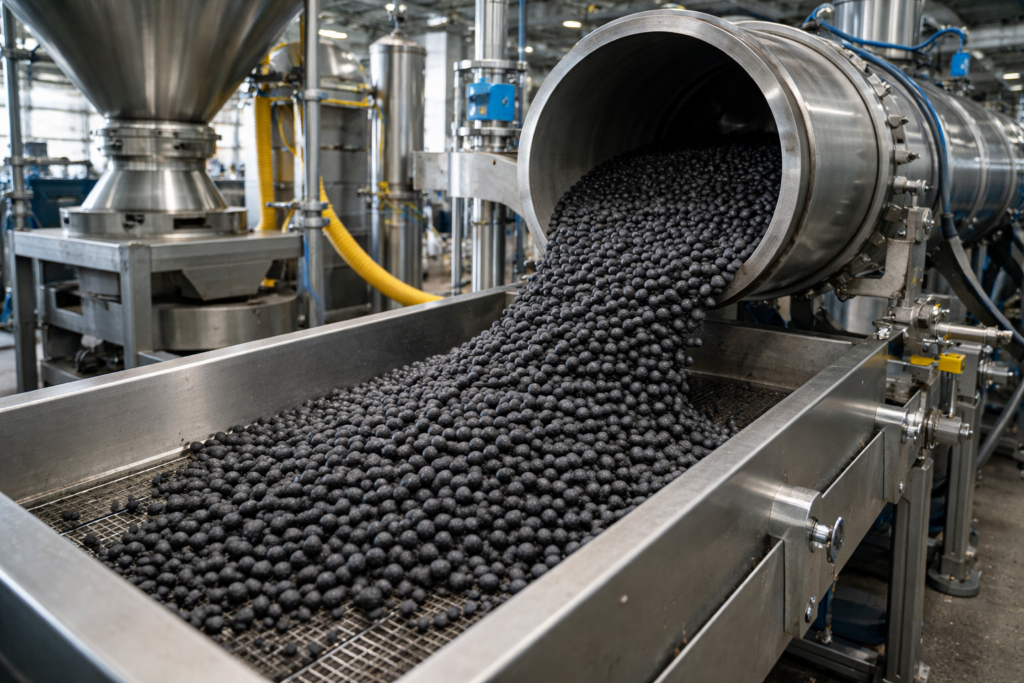
In the current conditions of the European Union, the problem of digestate is increasingly determined not by its agronomic properties, but by the inconsistency of the product form with regulatory, logistical and market requirements. That is why in scientific research of the last decade, granulation is considered not as an auxiliary operation, but as a key element of the technological valorization of digestate.
Studies by Mangwandi et al. show that the granular form significantly reduces the variability of nutrient composition compared to liquid or paste digestate. This is critical for compliance with the requirements of Regulation (EU) 2019/1009, which provides for reproducibility of composition, control of dosage and predictable behavior of the fertilizer in the soil.
From a logistical perspective, granulation:
In the works of Yu et al. (Sustainability) it was experimentally proven that granules based on digestate and porous carriers demonstrate stable mechanical characteristics and controlled release of nitrogen and potassium. The authors emphasize that it is the granular form that allows to transfer digestate from the category of “bulk organic input” into a standardized agricultural product suitable for interregional circulation.
From a regulatory perspective, this is essential for meeting the requirements of the Nitrates Directive (91/676/EEC). Granular forms allow:
Thus, granulation acts as a tool for adapting digestate to the real rules of the EU game, and not just a technological operation.
A previous AVELIFE publication showed that thermal conversion of digestate to biochar is an effective way to transform the unstable biogas byproduct into a long-lasting carbon resource. A key finding of that work was that the formation of a stable matrix is a necessary condition for nutrient management.
Sorption and granulation logically continue this concept, but at a different level of technological intensity. If pyrolysis provides maximum carbon stabilization, then sorption-granulation technologies allow:
Scientific reviews by Chojnacka et al. and Senevirathne et al. confirm that composite systems “digestate + biochar + mineral sorbents” have significant advantages over single-component forms. Biochar in such systems performs the function of a carbon and sorption matrix, while silica-containing materials provide ion-exchange stabilization and structural strength of the granule.
It is this approach that is systematically implemented in AVELIFE’s technological developments:
Thus, the new publication does not duplicate the previous one, but rather expands the single methodological line of AVELIFE:
from stabilization → to controllability → to scaling.
Analysis of current scientific research indexed in Scopus shows that the future of digestate in the European Union is determined not by the volume of its production, but by the ability to convert it into a manageable, stable and regulatory acceptable form. In this context, sorption and granulation are not auxiliary technologies, but a full-fledged path to technological valorization, which allows integrating digestate into modern agricultural and bioeconomic systems.
Research by Chojnacka, Senevirathne, Yu, Wang and others confirms that the key limitations of digestate use are high nutrient mobility, logistical complexity and regulatory limits imposed by the Nitrates Directive. These limitations are effectively overcome by forming composite systems in which nutrients are bound in sorption matrices and converted into a granular form with controlled characteristics.
The combination of biochar with silica-containing materials creates a functional organo-mineral matrix capable of simultaneously:
Granulation plays a crucial role in this system, as it is what transforms digestate from a local by-product into a standardized agricultural resource suitable for interregional circulation, precise dosing, and compliance with the requirements of Regulation (EU) 2019/1009.
The coordination of the sorption-granulation approach with the previously described pyrolysis technology demonstrates the holistic methodological line of AVELIFE:
stabilization → controllability → scaling.
Depending on economic, energy and logistical conditions, both approaches can be applied either separately or in combined schemes, which expands the possibilities of practical implementation.
Thus, digestate sorption and granulation should not be considered as a compromise between ecology and agronomy, but as a tool for transitioning to a circular nutrient management model, in which digestate ceases to be a problematic surplus and becomes a managed agricultural resource of long-term action. It is this approach that corresponds to both modern scientific ideas and strategic goals of sustainable development of the agricultural sector in Europe and Ukraine.
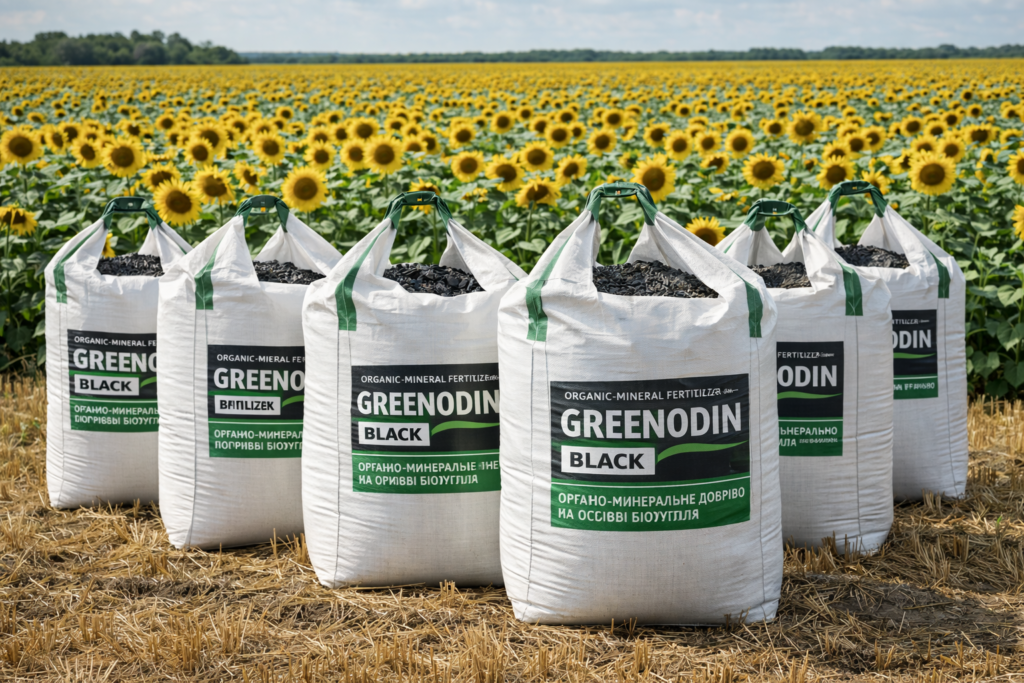
What are magnesian-organomineral materials, what is their potential for road construction, and why it is not worth promising “minus CO₂” without LCA.

The role of telomeres, telomerase, and gene therapy in controlling cellular aging. A simple explanation of complex biological processes.

How the gene therapy market works, why it is growing, what is holding it back, and why it is one of the most complex segments of modern biopharma


