


Returning life to the desert
Ecological breakthrough in combating desertification: artificial cultivation of biological crusts (biocrusts) in the deserts of the PRC. Accelerated bioremediation technology from AVELife.


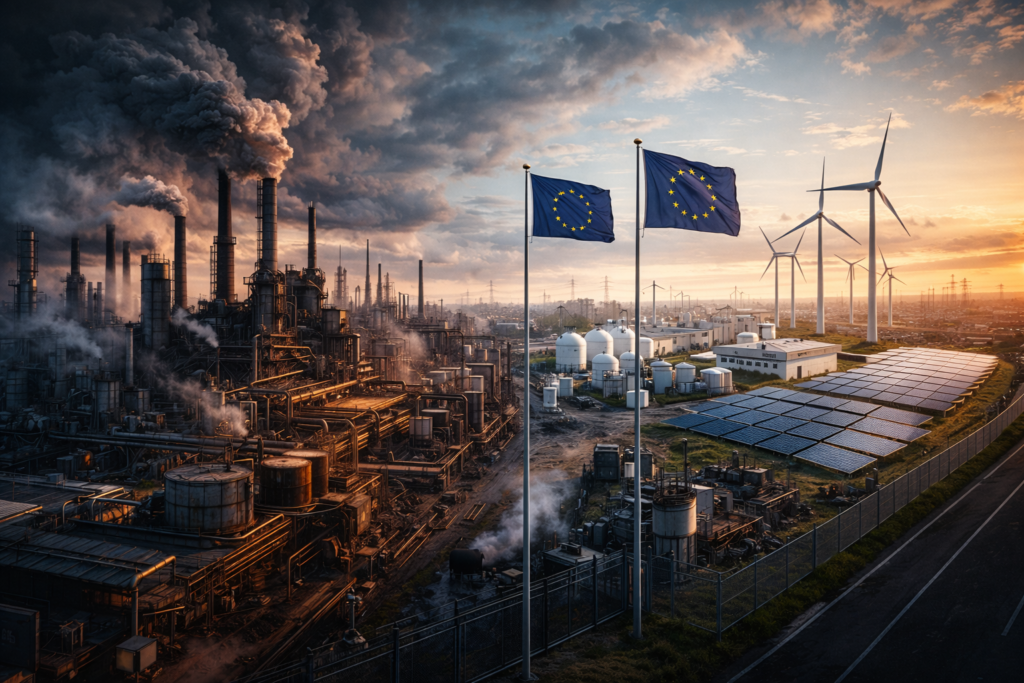
The Carbon Border Adjustment Mechanism (CBAM) is increasingly evidently going beyond climate policy.
In 2026, it functions not only as an environmental instrument, but also as a mechanism for economic and investment pressure on industrial economies outside the European Union.
Formally, CBAM aims to prevent “carbon leakage.” In fact, it forces companies and entire countries to invest in decarbonization under EU rules or lose market access.
This is not a sanction in the classical sense, but in terms of effect, it is comparable.
The European Commission openly positions CBAM as an element of the Green Deal and an extension of the EU ETS
(official regulatory framework).
However, in practical terms, CBAM:
According to the World Bank Carbon Pricing Dashboard (https://carbonpricingdashboard.worldbank.org/), the average effective CO₂ price in the EU in 2024–2025 was 2–4 times higher than in most countries in Eastern Europe and the Global South.

CBAM equalizes this difference not through aid, but through a financial penalty on imports.
CBAM does not punish emissions per se. It punishes the lack of decarbonization investments that meet EU standards.
For companies outside the ETS this means:
The OECD, in its reports on industrial decarbonization, explicitly states that CBAM “changes the investment attractiveness of industrial assets outside the EU.” (https://www.oecd.org/industry/industrial-decarbonisation/).
Unlike classic trade barriers:
As a result:
This is the key element of asymmetric pressure.
In 2024–2025, metallurgical, cement, and chemical companies from Eastern Europe faced a typical scenario:
McKinsey notes in its analytical materials that CBAM “actually accelerates the relocation of investments within the EU” (https://www.mckinsey.com/capabilities/sustainability/our-insights).
In 2026, CBAM will be integrated into TCO:
CBAM ceases to be an environmental tool.
It becomes a filter of capital.
European companies already use internal risk matrices, where:
influence decisions about:
This is a structural change, not a temporary trend.
CBAM Investment Pressure Check:
❗ If 3 or more “no” answers are given, the company is under high investment pressure from the EU.
Ecological breakthrough in combating desertification: artificial cultivation of biological crusts (biocrusts) in the deserts of the PRC. Accelerated bioremediation technology from AVELife.

Research on the transfer of space technology of the PRC (Chang’e mission) to combat land degradation. How continuous basalt fiber (CBF) fixes the Gobi and Takla Makan deserts.

Analysis of China’s large-scale eco-engineering program. Basalt fibers, artificial biocrust, and agrovoltaics in the fight against the Gobi and Takla Makan deserts by AVELife.