


Returning life to the desert
Ecological breakthrough in combating desertification: artificial cultivation of biological crusts (biocrusts) in the deserts of the PRC. Accelerated bioremediation technology from AVELife.


Global Environmental Trend: Regeneration and Eco-Engineering of Disturbed Landscapes (2025–2026)
The problem of land degradation and global desertification has now gone beyond local environmental threats and has become a systemic challenge for the global economy. Against the backdrop of climate change in 2025–2026, when traditional methods of “green camouflage” and declarative slogans have finally proven their ineffectiveness, the concept of regenerative nature management is coming to the fore. The largest and most technologically unprecedented example of such a transformation is demonstrated by the PRC.
With about 27% of its land area classified as arid and semi-arid, China has been able to radically reverse the trend of expanding the Gobi and Taklamakan deserts. Manual labor and haphazard planting of drought-resistant crops have given way to a deep synergy of basic science, materials science, and automated engineering systems.
One of the most important recent breakthroughs has been the introduction of materials developed under the national space program (in particular, the Chang’e lunar missions). The Chinese Academy of Sciences has adapted the technology for producing high-strength basalt fibers to stabilize shifting sands.
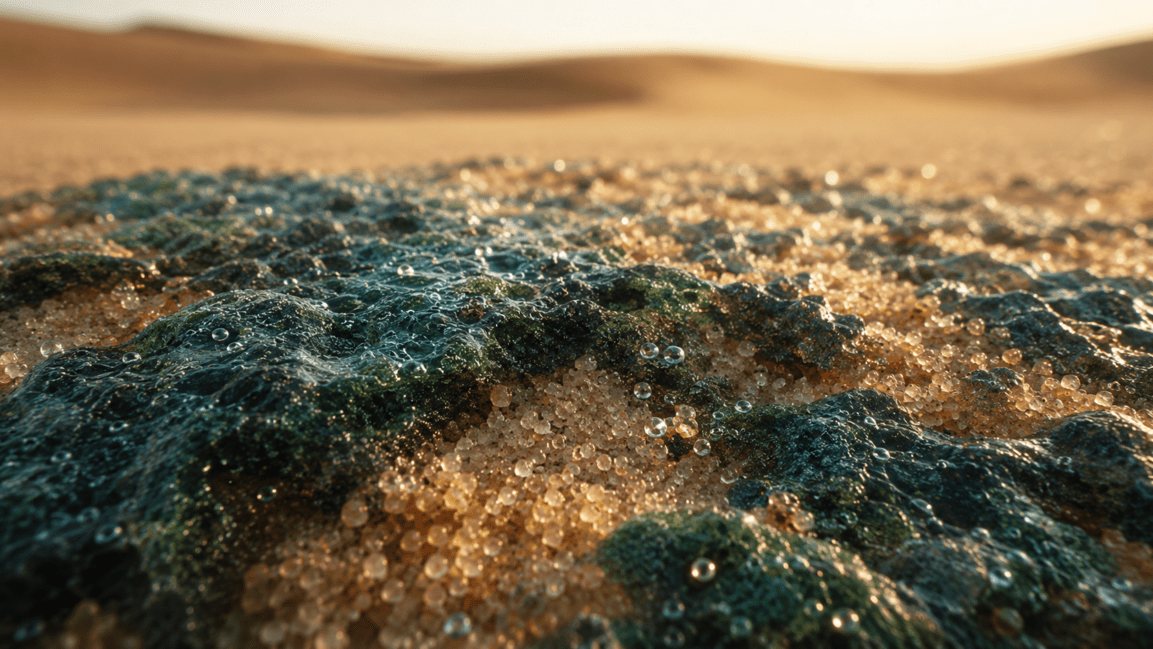
Traditional approaches to sand fixation often ignore the fact that desert substrates are devoid of microbiomes. Chinese scientists have changed the paradigm by applying accelerated bioremediation.
Instead of waiting for the natural formation of a fertile layer, the dune surface is treated with a concentrated liquid solution based on cyanobacteria (blue-green algae). This process allows for the artificial creation of a so-called biological crust (the “ecological skin” of the soil).
Time acceleration effect: In the natural environment, a stable biocrust takes 5 to 10 years to form. Innovative microbiological technology reduces this period to just 10–16 months. The resulting dark film reliably binds sand microparticles, accumulates scarce moisture and triggers the natural cycle of carbon and nitrogen metabolism.
The historic Chinese method of creating sand barriers in the form of a checkerboard of straw (草方格) has received a complete digital and mechanized modernization:
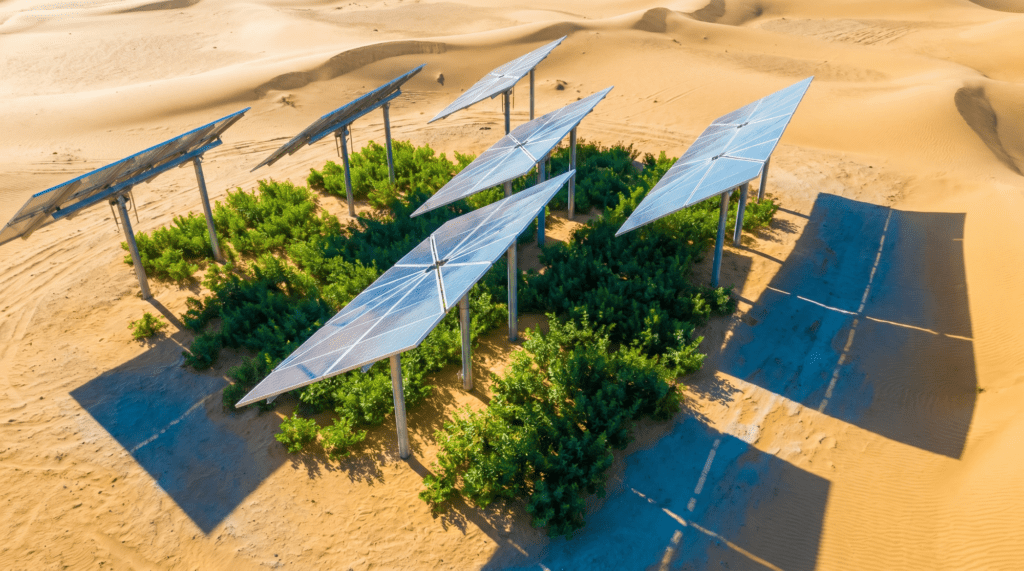
China has combined the decarbonization of the energy sector with land restoration, creating the concept of “solar farming.” Huge arrays of photovoltaic panels are installed directly in desert areas where maximum insolation is recorded.
A physical screen in the form of panels absorbs excess solar radiation, reducing the surface temperature of the sand by 4–8 °C and significantly slowing the evaporation of residual groundwater. Drought-resistant legumes, including licorice (Glycyrrhiza), are planted in shaded inter-rows. It not only fixes atmospheric nitrogen, enriching poor soil with organic matter, but also serves as a valuable raw material for the global pharmaceutical industry.
| Technology stack | Physical/Biological mechanism | Speed of achieving the effect | Additional benefit |
|---|---|---|---|
| Basalt geogrids | Mechanical retention of kinetic energy of sand | Instantly (after styling) | Environmentally neutral, durable |
| Cyanobacterial biocrust | Microbiological bonding and nitrogen regeneration | 10–16 months (instead of 10 years) | Formation of the primary desert biocenosis |
| Agrovoltaic complexes | Radiation shielding + evaporation reduction | Medium-term (1–2 seasons) | Clean electricity generation, income from licorice |
| Space breeding and hydrogels | Osmotic moisture retention + salt tolerance of biomass | During the growing season | Production of raw materials for biofuels (Arundo) |
China’s experience clearly proves the main thesis of modern agrotechnology: a desert or degraded soil is not a sentence, but a specific mineral substrate, the state of which can and should be managed. The strategic approach of the PRC fully corresponds to the philosophy of our institute – “Engineering instead of slogans.”
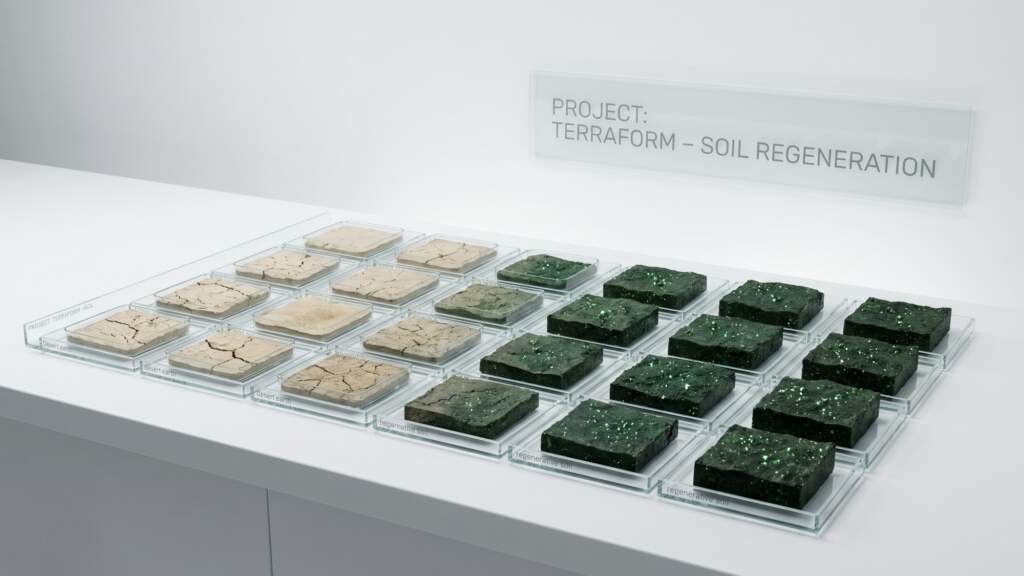
Interestingly, the mechanisms used in China to combat desertification have a direct conceptual affinity with advanced regenerative agriculture technologies being developed in Europe and Ukraine. In particular, the synergy of microbiological consortia and mineral matrices underlies domestic organo-mineral complexes (such as the GREENODIN series based on natural phyllosilicate – glauconite).
While China uses cyanobacteria to create a surface film, the use of glauconite complexes in combination with beneficial soil bacteria allows for similar tasks to be solved from within the soil profile:
The global trend is obvious: the future of the agricultural sector and environmental safety does not belong to chemical intensification, but to the intelligent management of the physicochemical properties and biological activity of each plot of land.
The material was prepared by analysts of the Institute of Ecological Economics and Regenerative Technologies AVELife (2026). When reprinting or quoting, a link to avelife.pro is required.
List of sources (References):
Ecological breakthrough in combating desertification: artificial cultivation of biological crusts (biocrusts) in the deserts of the PRC. Accelerated bioremediation technology from AVELife.

Research on the transfer of space technology of the PRC (Chang’e mission) to combat land degradation. How continuous basalt fiber (CBF) fixes the Gobi and Takla Makan deserts.

Analysis of China’s large-scale eco-engineering program. Basalt fibers, artificial biocrust, and agrovoltaics in the fight against the Gobi and Takla Makan deserts by AVELife.