

Restoring soil fertility for sugar beet (Rivne region)
Strategy for increasing sugar content and yield. Use of GREENODIN organo-mineral mixtures for the restoration of depleted lands.


The success of sugar beet cultivation in Rivne region today depends not on the amount of NPK applied, but on the ability of the soil to provide these elements to the plant. Analysis shows that most of the region’s lands are depleted by intensive farming, which leads to a drop in sugar content.
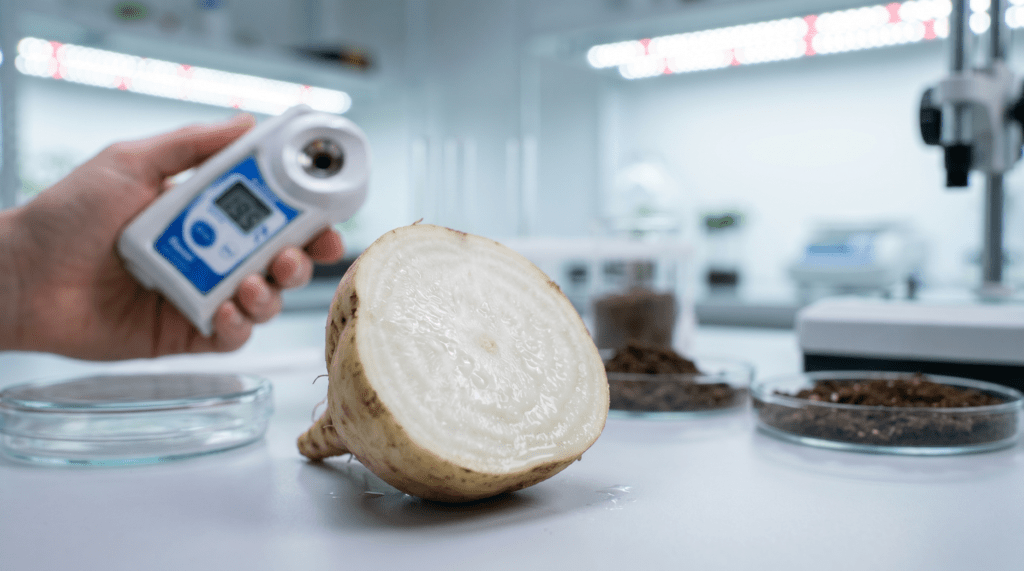
Low organic matter content (less than 2.5%) makes the soil hard, hindering root development. When the root encounters resistance, it deforms and the accumulation of sugars slows down.
Economic benefits of using GREENODIN BROWN
| Impact stage | Action of the drug | The result for the farmer |
|---|---|---|
| Sowing | Improving soil structure | Friendly seedlings and taproot development |
| Vegetation | Phosphorus mobilization and nitrogen fixation | Savings on mineral fertilizers up to 20-30% |
| Harvesting | Improving technological quality | Higher price per ton due to high sugar content |
This is not just a fertilizer, but a tool for soil resuscitation. For the Rivne region, where there is a deficiency of nitrogen and phosphorus against the background of an excess of potassium, this preparation becomes an ideal solution:
To obtain a yield of more than 600 c/ha in the conditions of the Rivne region, it is necessary to deviate from the patterns. Only by restoring the microbiological balance and correcting the pH can one achieve high profitability of sugar beet.
Strategy for increasing sugar content and yield. Use of GREENODIN organo-mineral mixtures for the restoration of depleted lands.

How to grow sugar beet at pH 8.0. Fertilization technology, combating phosphorus and moisture deficiency in the Rivne region.

Learn why fertilizers don’t work and how Greenodin increases the bioavailability of nutrients. Practical tips and case studies for farmers.