


Restoring soil fertility for sugar beet (Rivne region)
Strategy for increasing sugar content and yield. Use of GREENODIN organo-mineral mixtures for the restoration of depleted lands.


Most farmers count kilograms of applied fertilizers, but plants don’t care about your reports – they only care about the percentage of nutrition that they can actually absorb. If the soil is “blocked”, you pay for 100% of the fertilizers, but you get a 20% result, the rest becomes dead mass in the ground.
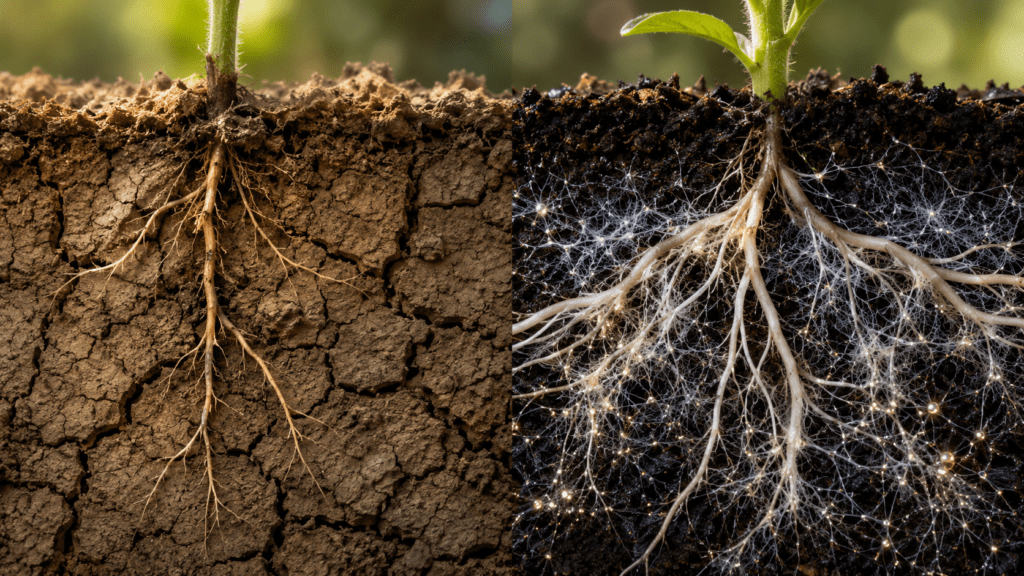
Even on fertile soils, plants often experience “hidden hunger.” Nutrients may be present in the soil in huge quantities, but in an inaccessible, chemically inert form. The plant “sees” them, but cannot “assimilate.” Therefore, a high agronomic background does not guarantee a harvest.
Even on rich black soil, plants can experience deficiencies. The main reason is the transition of elements into inaccessible, chemically inert forms.
In order not to work in vain, you need to use solutions that keep the elements in a moving state.
Common metal salts (sulfates) in the soil react quickly and precipitate. The chelate form is an “organic capsule” that protects the element until it reaches the plant.
The use of physiologically acidic or alkaline fertilizers allows you to locally change the environment in the root zone.
Mycorrhiza and phosphate-mobilizing bacteria convert difficult-to-access compounds (especially calcium phosphates) into a form that the root can “swallow.”
People often ask: is Greenodin a chelate form? This is a much broader concept. If a chelate is an individual “capsule” for a single micronutrient, then Greenodin is an entire infrastructure that changes the environment around the root.
| Characteristic | Common chelates | Greenodin |
|---|---|---|
| Principle of operation | Single item delivery | Unlocking Soil + Power Supplies |
| Composition | Metal + acid (EDTA, etc.) | Silicon base + biota + humates |
| Duration | Short-term effect | Works all season, accumulating humus |
| Impact on soil | Neutral | Reanimates the structure and balances pH |
The silicon base of the drug mechanically displaces phosphates from insoluble bonds, and specific microorganisms convert them into “easy food” for the roots.
Object: Farm in the southern region, carbonate soils (pH 8.1). Problem: Constant phosphorus deficiency in winter crops, despite high rates of ammophos. Solution: Reducing the rate of mineral fertilizers by 25% + applying Greenodin to the row during sowing. Result: The phosphorus absorption coefficient from the soil increased by 35%. Costs per hectare decreased, and the development of the root system improved by 40% compared to the control plot.

Would you like to calculate the Greenodin rate for your crop? Write to us and we will select a scheme for your soil type.
Strategy for increasing sugar content and yield. Use of GREENODIN organo-mineral mixtures for the restoration of depleted lands.

How to grow sugar beet at pH 8.0. Fertilization technology, combating phosphorus and moisture deficiency in the Rivne region.

Learn why fertilizers don’t work and how Greenodin increases the bioavailability of nutrients. Practical tips and case studies for farmers.