


Returning life to the desert
Ecological breakthrough in combating desertification: artificial cultivation of biological crusts (biocrusts) in the deserts of the PRC. Accelerated bioremediation technology from AVELife.


Global climate change, land degradation, water scarcity and the expansion of arid zones are forcing humanity to reconsider the very logic of landscape restoration. According to UNCCD estimates, up to 40% of the world’s land is already degraded, affecting over 3 billion people and directly related to food security, biodiversity and climate resilience. https://www.unccd.int/sites/default/files/2025-05/DDD%20factsheet%20EN.pdf
For the Institute of Nanotechnology and Organic Products AVELIFE, it is fundamentally important to distinguish between two levels of combating desertification.
That is why we view the new Chinese experience with basalt fibers not as a separate technological sensation, but as part of a broader eco-engineering model:
strong mineral framework on the outside + living organo-mineral system inside the soil.
In 2024, China’s Chang’e-6 mission became famous not only for returning samples from the far side of the Moon, but also for displaying a flag made of basalt fiber. Chinese sources reported that the threads for this flag were obtained from natural basalt by crushing, high-temperature melting, and drawing into thin fibers. https://en.people.cn/n3/2024/0918/c90000-20220311.html
In 2026, the Chinese Academy of Sciences announced the launch of three major technological projects in Xinjiang to create a complete protection chain of “desert-oasis-agricultural land”. One of the directions involves the development of environmentally friendly sand control materials, including those based on basalt fiber, materials from ash and slag waste, microbial seed coatings and modular equipment for mechanized laying of such systems. The stated goal is to improve the efficiency of sand control works, reduce costs and scale up the application in the southern edge of the Takla Makan Desert. https://www.cas.cn/cm/202604/t20260422_5107612.shtml
At the same time, it is important to be demonstrably correct. China does have a multi-year “green wall” program and has completed a protective belt around the Taklamakan about 3,000 km long, but this result was achieved not by one technology, but by a complex of measures: forest belts, shrubs, grass barriers, irrigation, agro-landscape planning and other methods. Reuter
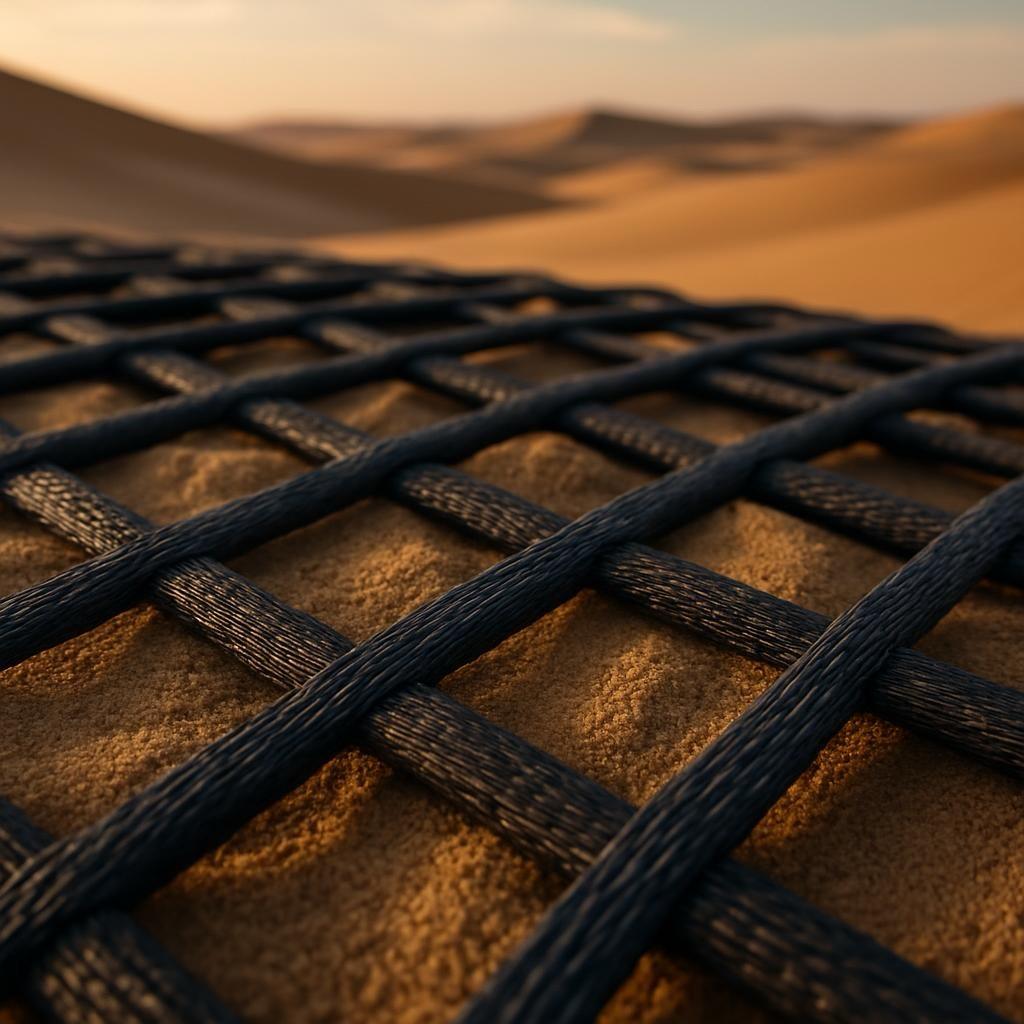
Basalt fiber is a material derived from a natural igneous rock. Basalt is melted at high temperatures, after which fine fibers are extracted from the melt, which can be used in fabrics, composites, geogrids, reinforcing meshes, and protective materials.
Scientific reviews and engineering sources note that basalt fibers have high strength, chemical resistance, thermal stability, and potential for composite materials.
The following functions are particularly important for desert and semi-desert conditions:
A key mistake in popular coverage of such technologies is that mechanical sand consolidation is sometimes presented as a complete solution to the problem of desertification.
In fact, basalt geogrid or geogrid performs mainly an engineering function:
But it does not automatically build fertility. It does not replace organic matter, does not create a full-fledged soil microbiome, does not accumulate humus, and does not solve the problem of a shortage of available moisture in the root zone.
Therefore, the correct strategy is not “basalt instead of soil,” but:
basalt as an external framework to start the soil formation process.
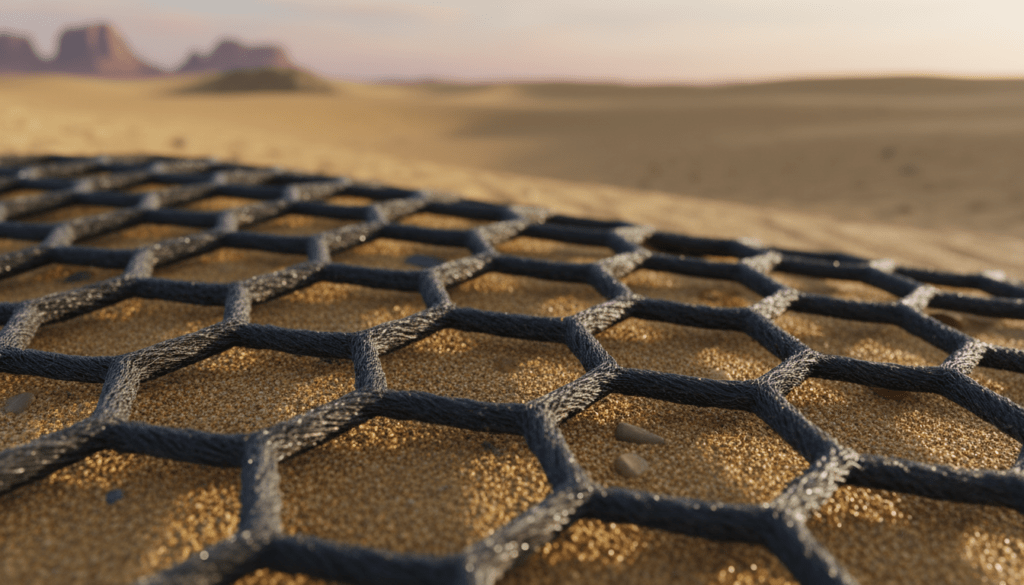
Analysts from the AVELIFE Institute note: basalt geogrids can brilliantly solve the mechanical task of stopping erosion and stabilizing moving sand. However, full soil regeneration requires a transition from a mineral framework to biological life.
This is where the prospect of technology synergy opens up.
It is advisable to combine the use of a basalt frame as an external support with intra-soil organo-mineral complexes, in particular with solutions from the GREENODIN / AVELIFE line based on natural mineral matrices, glauconite, organic matter, humic acids, fulvic acids, biochar, and beneficial microbiota.
While the basalt mesh keeps the dune geometry from the wind, the glauconite organo-mineral matrix, introduced into the cells along with the seeds of drought-resistant plants, can work within the soil profile: accumulate moisture, maintain mineral nutrition, create an environment for the microbiome, and help the plant overcome initial stress.
Glauconite is a natural potassium-containing iron-silicate mineral that is considered in agriculture as a source of gradual nutrition and as a soil conditioner. In its own publications, AVELIFE describes glauconite as a “long-term” mineral platform for the soil: it does not provide an instant effect like a quick-dissolving salt, but works as a natural reservoir of elements and as a structural component of fertility.
For arid and degraded lands, the following properties of the glauconite matrix are important:
The AVELIFE website separately discloses the “microbiome + silicon” approach, which emphasizes:
Effective soil management is not limited to applying a single product, but requires diagnostics, technology adaptation, control plots, and an honest assessment of the result.
A separate direction is overcoming salt stress in plants using glauconite and GREENODIN. This is especially important for arid zones, as desertification is often accompanied by secondary salinization, deterioration of the water regime, and osmotic stress for crops.
| Comparison and integration criterion | Basalt geogrid (Chinese experience) | GREENODIN / Glauconite complexes (AVELife eco-stack) |
|---|---|---|
| Main function | External mechanical frame, protection against wind erosion | Internal physicochemical and biological framework of the soil |
| Main action | Stopping sand movement, reducing wind speed, stabilizing the surface | Works as a natural moisture accumulator inside the soil capillaries |
| Interaction with moisture | Can retain dew and condensation on the surface, reduces moisture blowing | Works inside soil capillaries, increases buffering and moisture retention |
| Impact on fertility | Indirect: creates conditions for further greening | Active: supports soil life, mineral nutrition and root environment |
| Biological role | Not a source of microbiome | Can be a carrier and medium for agronomically useful microbiota |
| Environmental profile | Mineral alternative to plastic solutions, but requires control of composition and coatings | Requires control of composition, dosage, certification and field validation |
| The best role in the system | First stage: engineering stabilization | Second stage: regeneration, rooting, formation of living soil |
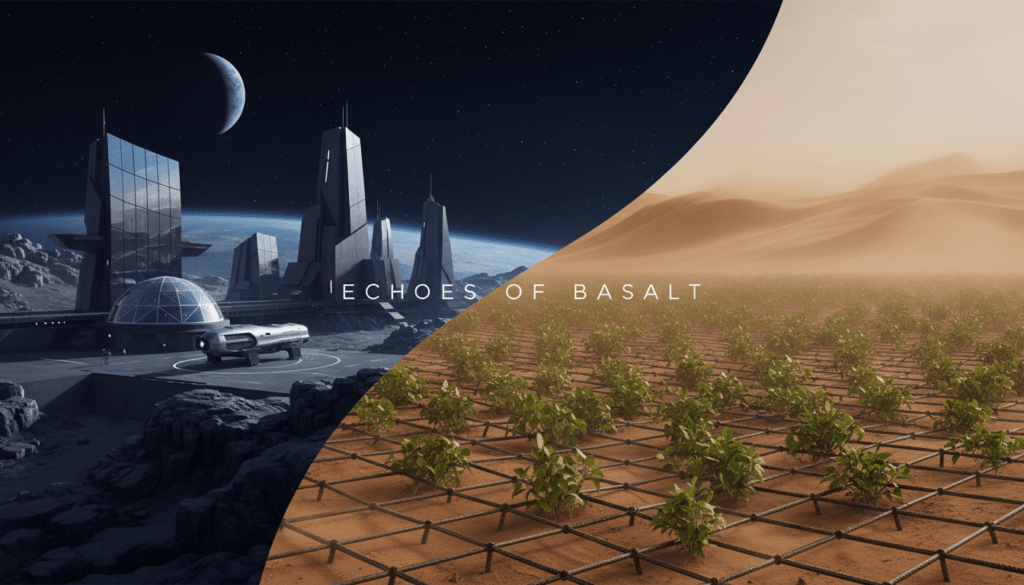
The AVELIFE Institute sees a promising model for combating desertification in the following sequence.
Grain size distribution, wind loading, salinity, pH, organic matter, water retention, presence of toxicants, risk of dust transport, and condition of natural vegetation are assessed.
In areas with moving sand or dust transport, a mineral or combined framework is installed: basalt geogrids, checkerboard barriers, microrelief elements, and wind protection strips.
A composition based on glauconite, organic matter, biochar, humic acids, fulvic acids, and a microbiological component is introduced into the cells or planting zones.
Drought-resistant, salt-tolerant and locally adapted plants are sown or planted: cereals, shrubs, honey plants, ground cover crops, green manures, halophytes for saline areas.
Not only the “green appearance” of the site is recorded, but also specific indicators:
This approach corresponds to the logic that AVELIFE has already described in materials on bioremediation of post-agrarian lands: soil degradation is manifested not only in the loss of nutrients, but also in the destruction of structure, the accumulation of agrochemical residues, and the reduction of soil microbiota activity.
The GREENODIN line is considered by the AVELIFE Institute not only as a fertilizer, but as an element of a broader system of soil restoration in the logic of a circular economy. The relevant AVELIFE publication states that innovative organo-mineral fertilizers can use recycled organic raw materials, reduce dependence on fossil resources, support soil microbiology and increase moisture retention.
In the context of desertification, this is of fundamental importance. Desertification occurs not only where there is a lot of sand. It occurs where the soil loses:
Therefore, the fight against desertification must be not only engineering, but also biological.
To deepen the topic, it is advisable to add a “Read also” block to the publication with materials from the AVELIFE Institute.
1. “China Stops Desertification: Top Technologies and Soil Regeneration” A review of modern Chinese approaches to combating desertification and the transition from mechanical stabilization to regeneration.
2. “Microbiological revolution: artificial biocrust in the fight against desertification” Continuation of the topic, where mechanical fixation of sand is supplemented by a living biological layer.
3. “Glauconite: A Green Mineral That Works for Soil Long-Term Benefits” Explanation of the role of glauconite in soil moisture retention, mineral nutrition, and buffering.
4. “Overcoming salt stress in plants: glauconite and GREENODIN” An example of applying glauconite logic to the problems of saline and stressed soils.
5. “Bioremediation of Post-Agrarian Lands” An evidence-based framework for the restoration of degraded soils after intensive agricultural use and military contamination.
6. “GREENODIN Innovative Fertilizers and Circular Economy Principles” Explaining why organo-mineral fertilizers, biochar and mineral matrices can be part of long-term fertility restoration.
Basalt fibers are a strong example of how space, defense, and materials science technologies can be transferred to the realm of Earth’s ecological restoration.
But the real victory over desertification doesn’t begin when we simply stop the sand. It begins when the stabilized soil re-establishes moisture, roots, microbiome, organic matter, biodiversity, and the earth’s ability to heal itself.
Therefore, the strategic formula of AVELIFE looks like this:
It is in this combination — engineering + mineralogy + microbiology + vegetation — that we see the future of combating land degradation, desertification, and loss of fertility.
The Institute of Nanotechnology and Organic Products AVELIFE considers this model as a promising direction for Ukraine, Central Asia, Africa and other regions, where soil degradation has become not a local agronomic problem, but a challenge to climate, food and environmental security.
Ecological breakthrough in combating desertification: artificial cultivation of biological crusts (biocrusts) in the deserts of the PRC. Accelerated bioremediation technology from AVELife.

Research on the transfer of space technology of the PRC (Chang’e mission) to combat land degradation. How continuous basalt fiber (CBF) fixes the Gobi and Takla Makan deserts.

Analysis of China’s large-scale eco-engineering program. Basalt fibers, artificial biocrust, and agrovoltaics in the fight against the Gobi and Takla Makan deserts by AVELife.