


Restoring soil fertility for sugar beet (Rivne region)
Strategy for increasing sugar content and yield. Use of GREENODIN organo-mineral mixtures for the restoration of depleted lands.


Sugar beet cultivation in the Rivne region has recently faced a serious challenge – increasing the soil pH level to 7.9–8.1. Under such conditions, even with the presence of fertilizers in the soil, the plant “starves” because most of the elements are converted into an inaccessible form.
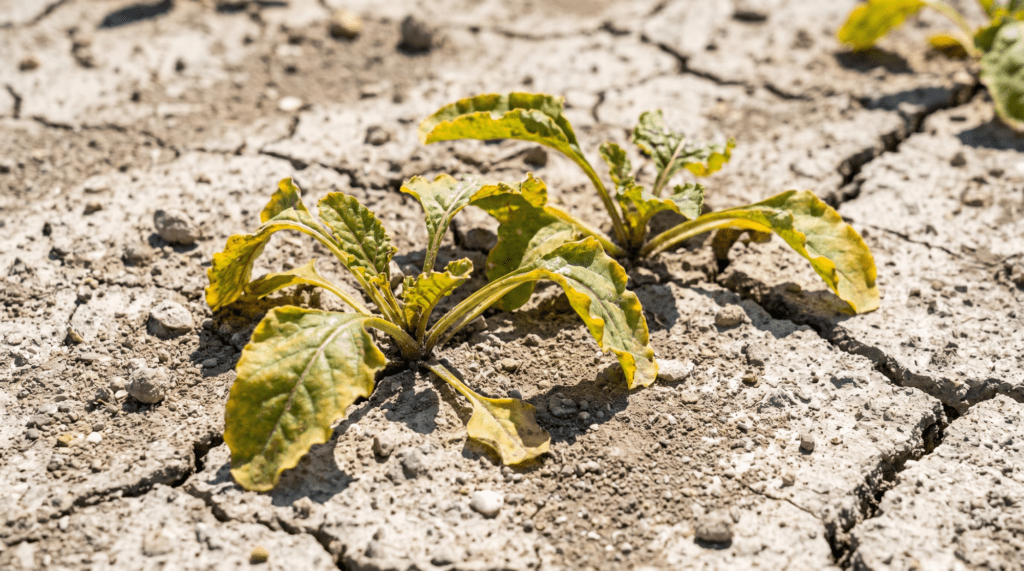
When the pH is above 7.5, phosphorus is bound by calcium, and trace elements (boron, manganese, zinc) become almost impossible for the root system to absorb. In practice, this means that you are applying expensive fertilizers, but the plant simply does not see them.
Comparison table: Soil indicators vs Optimum
| Indicator | Actual condition (average) | Optimal level | Impact on beets |
|---|---|---|---|
| Acidity (pH) | 7.9 — 8.1 (Alkaline) | 6.5 — 7.0 | Phosphorus and boron blocking |
| Humus | 1.9% — 2.4% | > 3.0% | Low moisture capacity, weak structure |
| Nitrogen (light hydrogen) | 75.6 — 86.8 мг/кг | > 120 мг/кг | Slow start and top growth |
| Mobile Potassium | 240 — 310 мг/кг | 150 — 200 мг/кг | Excess can degrade the quality of the juice |
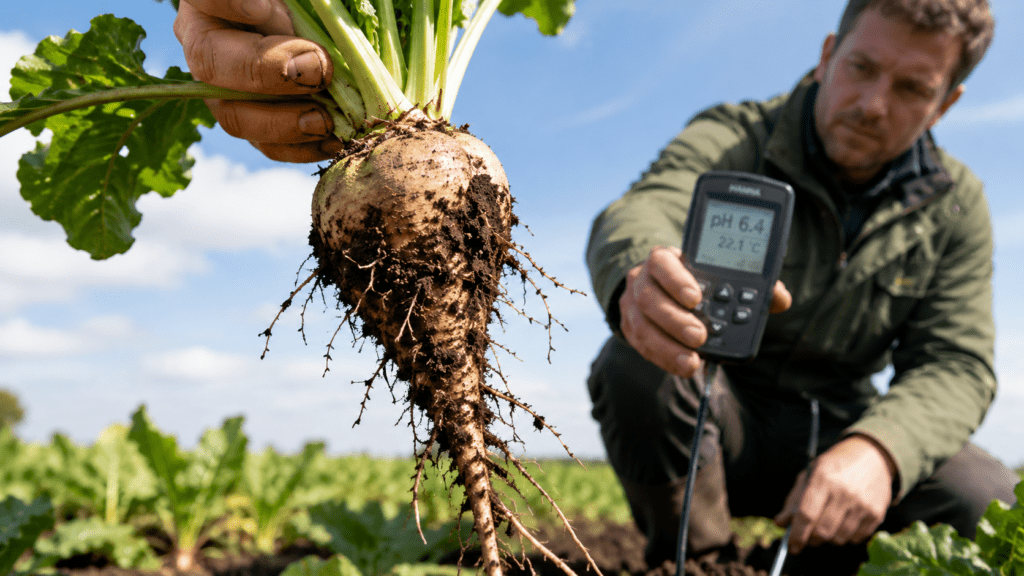
To obtain a stable result on such soils, it is necessary to act systematically. The main task is to locally lower the pH in the root zone and activate the microbiota.
Sugar beet requires 600-700 mm of precipitation per year. With a low humus content (as in our case – up to 2.4%), the soil quickly loses water. The use of silicon-containing preparations and organic matter allows the plant to more easily tolerate temperature stresses and use morning dew more effectively.
Strategy for increasing sugar content and yield. Use of GREENODIN organo-mineral mixtures for the restoration of depleted lands.

How to grow sugar beet at pH 8.0. Fertilization technology, combating phosphorus and moisture deficiency in the Rivne region.

Learn why fertilizers don’t work and how Greenodin increases the bioavailability of nutrients. Practical tips and case studies for farmers.